The most profitable colony in the Caribbean, built on mass death
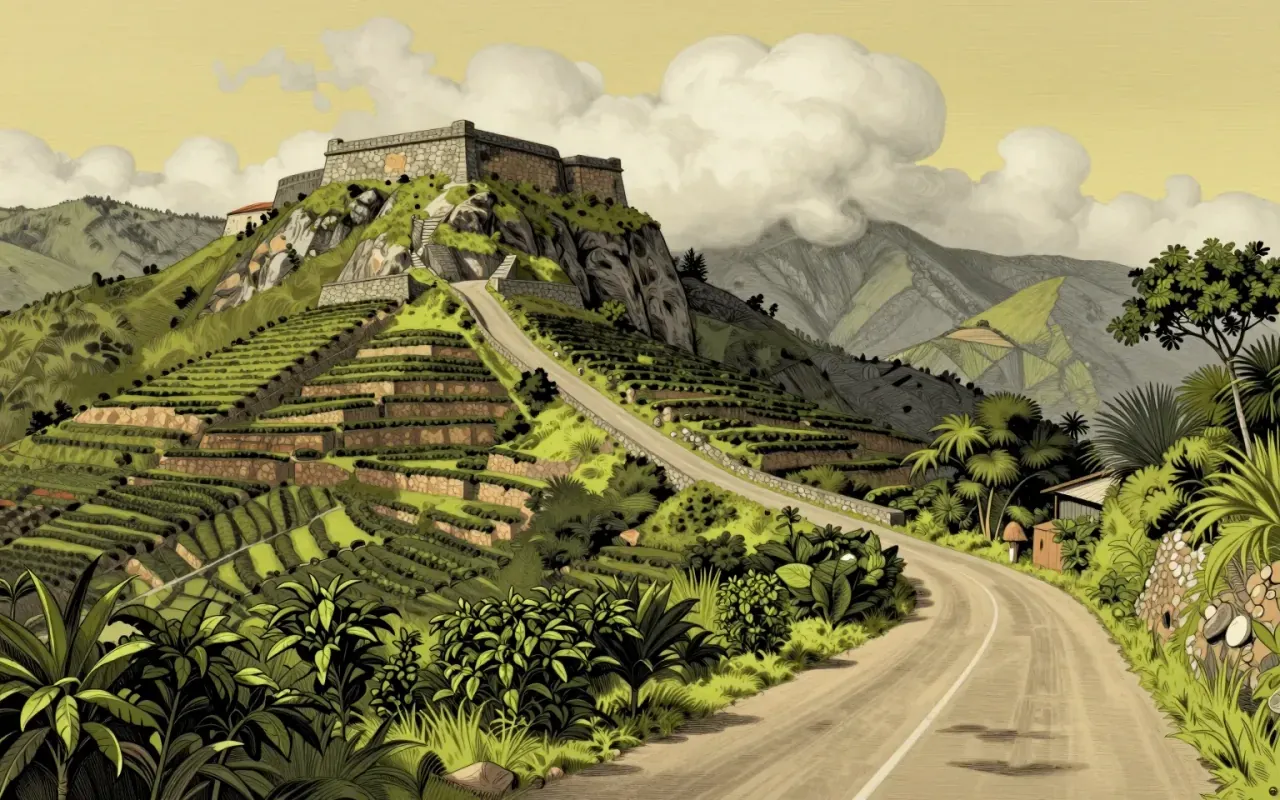
Saint-Domingue, France’s Caribbean colony on the western part of Hispaniola, produced around sixty per cent of the world’s coffee and forty per cent of the sugar imported into France and Britain by 1789, an economy built on the forced labour of roughly 452,000 enslaved people governed by around 40,000 white colonists, under conditions so severe that at least half of newly arrived enslaved people died within their first year. Rebellion broke out in August 1791, and over the following thirteen years the conflict drew in French, Spanish and British forces before culminating, after Napoleon’s failed attempt to reassert French control through the Leclerc expedition of 1802, in the declaration of Haitian independence on 1 January 1804, the first and only time a slave revolt succeeded in establishing an independent state.
A portrait, a constitution, and casualty figures no one can verify
Documentary evidence for the revolution includes Toussaint Louverture’s 1801 constitution, which explicitly abolished slavery in its text, the earlier writings of Guillaume Raynal, whose Enlightenment-era criticism of slavery is sometimes cited as having anticipated the uprising, and visual material such as a 1797 portrait of the free Black officer Jean-Baptiste Belley, which historians read as reflecting the period’s simultaneous celebration and diminishment of Black colonial subjects by French artists. Casualty figures for the conflict, generally cited as around 200,000 enslaved deaths, 100,000 British deaths or woundings, and tens of thousands each of French and white colonist deaths, derive from military records compiled amid colonial administration and revolutionary upheaval, and historians treat their precision with real caution given the conditions under which they were produced.
Rights of Man on paper, slavery in practice
The French Declaration of the Rights of Man and of the Citizen, proclaimed in August 1789, asserted universal freedom and equality in terms that stood in obvious contradiction to the institution of slavery still enforced in France’s own colonies, a contradiction that free people of colour in Saint-Domingue invoked directly when demanding rights denied them under discriminatory colonial law. The 1791 execution of Vincent Oge, a free man of mixed race who had led an earlier uprising demanding voting rights, is credited in the historical record with directly motivating the subsequent and much larger rebellion by enslaved people later that same year, connecting revolutionary ideology imported from France with resistance traditions, including Vodou religious practice, that had developed independently among the enslaved population itself.
The revolution historians say gets written out of the story
The historian Michel-Rolph Trouillot has argued that the Haitian Revolution has been systematically overshadowed by the historiography of the French Revolution, receiving comparatively little public attention despite representing, in his assessment, a more genuinely transformative event for the institution of slavery than the French Revolution itself achieved. Scholars continue to debate how much weight to give French revolutionary ideology as opposed to African-derived resistance traditions in explaining the uprising’s origins, and how much credit belongs to individual leadership, particularly Toussaint Louverture’s synthesis of Enlightenment political language with the cause of liberation, versus the sustained organisation and mobilisation of the enslaved population as a whole.
Independence in 1804, and an immediate demand for reparations
Haiti’s declaration of independence in January 1804 established the Empire of Haiti as the first independent Black-led nation in the Americas, with former enslaved people becoming property-owning citizens and, in many cases, military personnel in the new state. The revolution’s success terrified slaveholding societies elsewhere in the Americas and inspired abolitionist movements more broadly, but Haiti itself faced sustained international isolation and, notably, was compelled to pay a substantial independence debt to France in compensation for former colonists’ property losses, including the human beings the revolution had freed, a financial burden that shaped Haiti’s economy for generations afterward.
A history worth reading against its own historiographical neglect
The Haitian Revolution rewards attention precisely because of the historiographical neglect Trouillot identifies: a revolution that achieved something no other slave uprising in history managed, the establishment of a sovereign state founded on abolished slavery, has nonetheless occupied a smaller place in general historical memory than the French Revolution that helped inspire it. Readers interested in the Age of Revolutions will find in Haiti’s story a direct challenge to any account of that period centred solely on Europe and North America; readers interested in the mechanics of the uprising itself will find a conflict whose casualty figures, like much of its documentary record, were produced under colonial administration and should be read with corresponding caution.