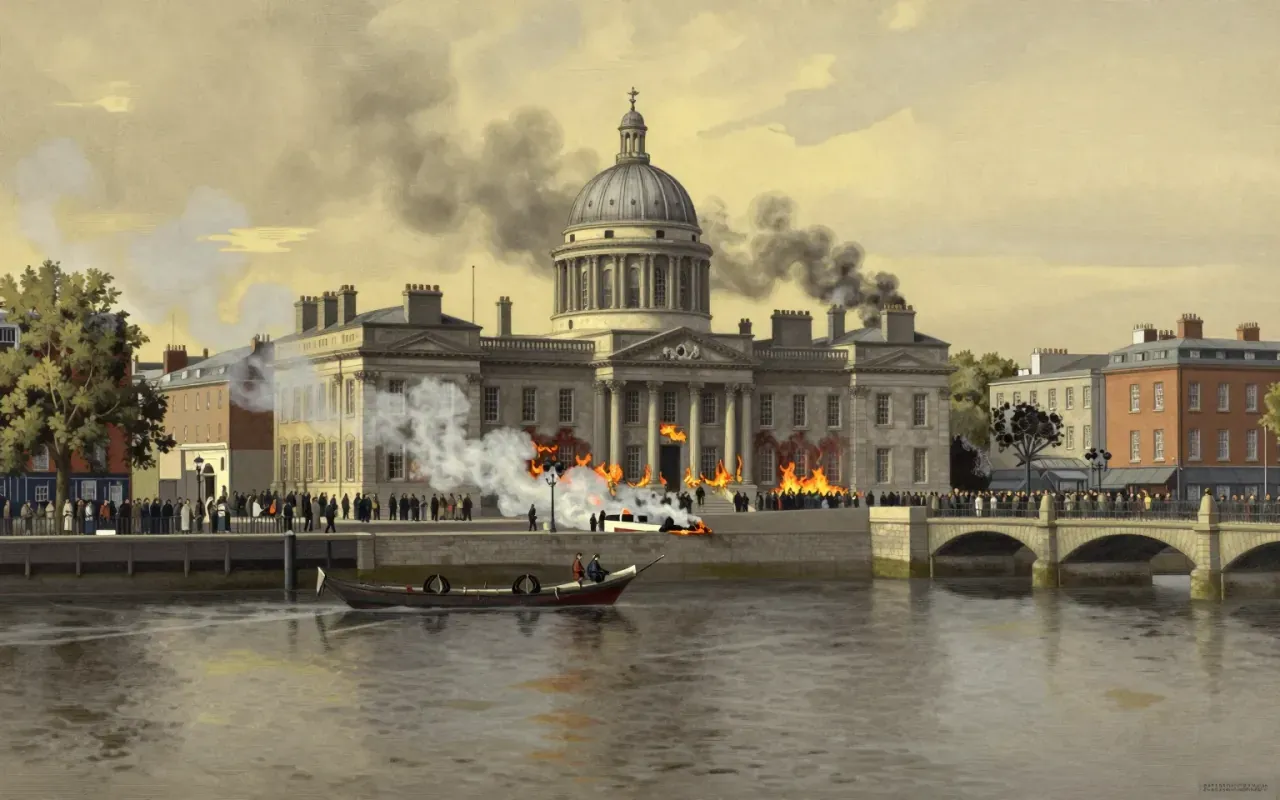
A lucky escape from execution
Collins served as aide-de-camp to Joseph Plunkett during the 1916 Easter Rising and, after the surrender, avoided the fate of the executed leaders through what his biographer Tim Pat Coogan describes as one of the luckiest escapes of his life: a chance movement between groups during processing at Richmond Barracks placed him among prisoners sent to internment in Wales rather than those selected for court martial and execution. Released within the year, he went on to become a central figure in Ireland’s War of Independence from 1919 to 1921, serving simultaneously as Minister for Finance, Director of Intelligence, and Director of Organisation for the Irish Republican Army.
A network reaching inside the administration
Collins built an intelligence operation that reached, according to the documented record, deep into the British administration in Ireland, recruiting informants across multiple levels of the colonial bureaucracy and police. He also organised a specialised unit known as the Squad, tasked with assassinating British agents and informers, and separately raised nearly four hundred thousand pounds through a National Loan to fund the fledgling Irish Republic’s operations. This combination of covert intelligence work and public fundraising gave Collins an operational reach across both the underground and the more conventional political sides of the independence movement that few contemporaries could match.
Bloody Sunday and its retaliation
On 21 November 1920, a day later known as Bloody Sunday, Squad members carried out coordinated killings of several British intelligence operatives across Dublin in a single morning, a operation widely attributed to Collins’s planning. In retaliation that same afternoon, police opened fire on a crowd at a Gaelic football match at Croke Park, killing twelve people and wounding around sixty more, an event that hardened public sentiment against British forces and is recorded as one of the war’s most consequential single days precisely because the retaliation’s civilian toll drew more lasting attention than the original operation itself.
A treaty he expected to cost him
As one of five Irish plenipotentiaries negotiating in London between October and December 1921, Collins helped produce the Anglo-Irish Treaty, signed on 6 December, which established the Irish Free State as a self-governing dominion still requiring an oath of allegiance to the Crown, terms he defended afterward as offering the freedom to achieve freedom rather than full independence outright. Winston Churchill, present at the negotiations, later recalled Collins’s visible anger at Lloyd George’s ultimatum forcing the decision, and Collins himself told the British official F. E. Smith upon signing that he might have just signed his own actual death warrant, a remark documented at the time rather than invented afterward.
An ambush still argued over
Collins served as chairman of the new Provisional Government and commander-in-chief of its National Army during the civil war that broke out between treaty supporters and opponents, and on 22 August 1922 he was ambushed and killed at Béal na Bláth in his native County Cork by anti-treaty forces. The precise circumstances of the ambush, including exactly who fired the fatal shot and why Collins’s convoy took the specific route it did, remain disputed among historians working from incomplete and sometimes contradictory contemporary accounts, a genuine gap in the record rather than a settled matter obscured only by popular myth-making.
A legacy built on compromise
Collins’s career is worth attention for the consistency of a single trait running through it: a willingness to accept incomplete outcomes, partial freedom through the treaty, imperfect intelligence through a network built on human informants rather than certainty, when the alternative was no progress at all. That same pragmatic acceptance of compromise is what made the treaty possible and also what got him killed within the year, by former comrades who considered the compromise itself a betrayal, a tension that makes his death read less as a random tragedy than as the direct consequence of the choice that defined his greatest political achievement.