Rising through removal of rivals
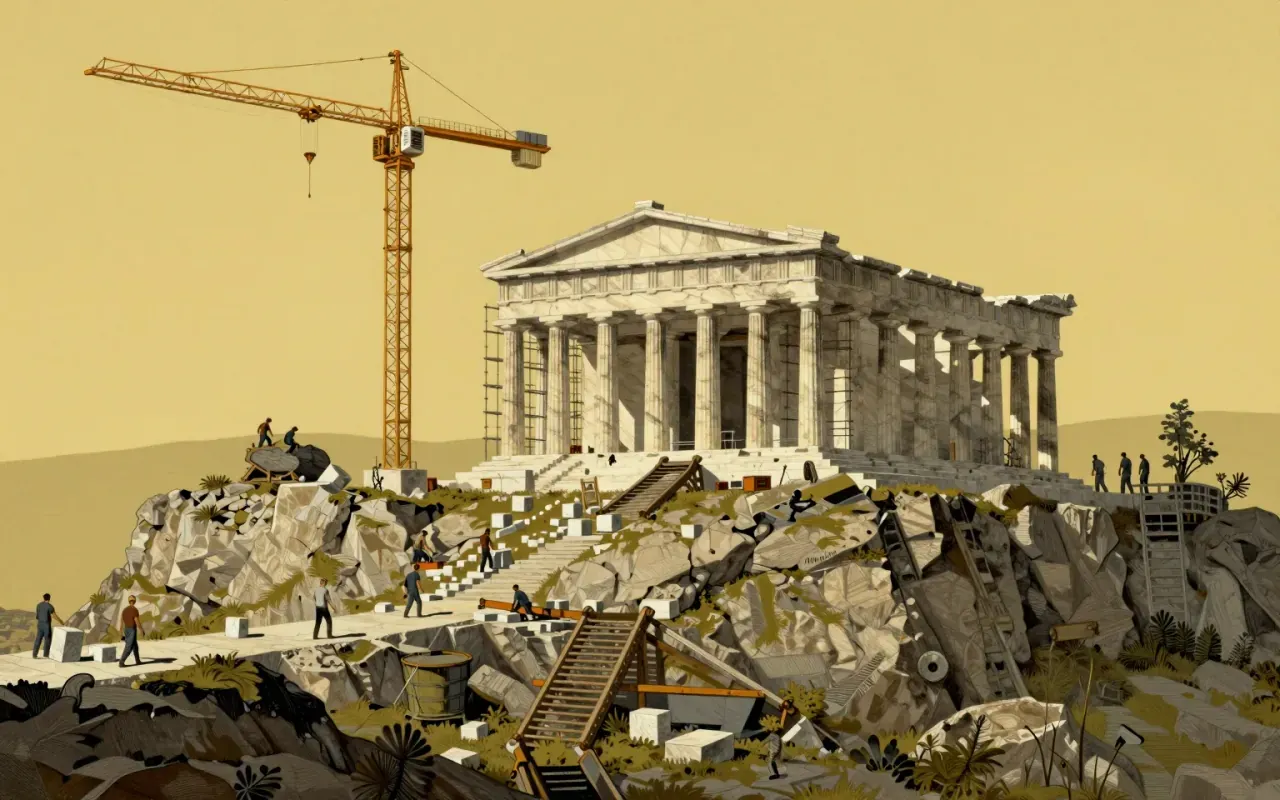
Born around 495 BC in Athens to an aristocratic family, Pericles entered public life through legal prosecution of political rivals in the 460s and rose to dominance after helping engineer the ostracism of the conservative statesman Cimon in 461 BC. He solidified unchallenged leadership in 442 BC by defeating a further rival, also named Thucydides, in a political contest that led to that man’s own ostracism. Over the following decades Pericles directed Athenian military expeditions, commanded fleets in campaigns from Sicyon to Cyprus, and launched an ambitious building programme funded partly by treasury moved from the Delian League’s original home on Delos to Athens itself, financing the Parthenon and other monuments still standing today. He led Athens into the Peloponnesian War against Sparta in 431 BC and died from the plague that swept the city two years later, in 429 BC, at around sixty-five or sixty-six years old.
A speech reconstructed from memory
The two central ancient sources on Pericles pull in noticeably different directions. Thucydides, a contemporary historian who lived through the events he described, portrayed Pericles as Athens’s first citizen, a leader who guided popular opinion rather than simply following it, and included in his history a celebrated funeral oration attributed to Pericles that Thucydides himself admitted reconstructing from memory rather than any verbatim record. Modern scholars remain divided over how much of that speech reflects Pericles’s actual words: Ioannis Kakridis has argued Thucydides substantially invented or reshaped its content, while Arnold Gomme has defended its essential fidelity to Pericles’s real ideas. Plutarch, writing centuries later as a biographer rather than a contemporary witness, supplied additional colourful anecdotes, including claims about Pericles’s unusually shaped skull, while the comic playwright Aristophanes offered a far less flattering contemporary caricature, comparing him satirically to Zeus while criticising his policies in front of Athenian theatre audiences.
Monuments funded by redirected treasury
Pericles built his political dominance by systematically removing rivals through the same formal democratic mechanisms, prosecution and ostracism, that Athenian institutions made available to any citizen willing to use them aggressively, turning tools designed to check individual power into instruments that concentrated it in his own hands over roughly two decades. His decision to redirect Delian League treasury from its original defensive purpose toward Athenian civic monuments reflected a broader strategy of converting Athens’s military leadership of an alliance into something closer to an empire run for Athenian benefit, a move that generated resentment among allied states even as it produced the architectural legacy for which Periclean Athens remains best remembered. His strategy in the opening years of the Peloponnesian War, avoiding open land battle with Sparta’s superior army in favour of naval strength and defensive walls, reflected calculated risk management, requiring political discipline to sustain since it meant tolerating visible enemy devastation of Athenian farmland without responding directly.
Blame for a war still argued over
Historians remain divided on Pericles’s responsibility for the Peloponnesian War itself, with Thucydides’s own account hinting that Spartan fear of growing Athenian power, rather than Athenian aggression, drove the conflict, while Plutarch instead suggested Pericles and Athens incited the war through arrogance, and the modern historian Karl Julius Beloch went further still, arguing Pericles deliberately provoked conflict to shore up his own domestic political position. His wartime military strategy is judged just as differently: Donald Kagan dismissed it as wishful thinking undermined by insufficient financial planning, while other historians, including Platias and Koliopoulos, argue Athens only began losing once its later leaders abandoned Pericles’s original defensive approach for more aggressive alternatives. Even his broader political character divides ancient and modern opinion, since Plato explicitly rejected the idealised view of Pericles, arguing his leadership had made Athenians lazy, talkative and greedy rather than genuinely virtuous, a sharply critical assessment standing in direct tension with Thucydides’s far more admiring portrait.
A legacy split between ideal and empire
The building programme Pericles financed left Athens with monuments, above all the Parthenon, that later observers credited with rendering the very name of Greece immortal in world culture, an architectural inheritance that has long outlasted the political system that produced it. His funeral oration, whatever its exact relationship to his actual words, became one of the most frequently cited statements of participatory democratic ideals in the entire Western political tradition, still invoked centuries later in discussions of civic identity and democratic values far removed from fifth-century Athens. His imperial management of the Delian League, however, drew sharp criticism even in antiquity and from modern historians including Victor Ehrenberg, who argue that Athenian domination over supposedly allied states actually undermined the very democratic principles Pericles is otherwise credited with championing, leaving his legacy permanently split between celebrated democratic statesman and architect of an increasingly resented imperial system that his own successors ultimately could not sustain through to victory.
A reputation built on contested sources
Pericles rewards close attention precisely because the most celebrated single artefact of his career, the funeral oration that shaped centuries of thinking about democratic citizenship, may not actually be his own words at all, a genuine uncertainty that ought to complicate any simple reading of him as democracy’s clearest historical spokesman. Readers should hold his reputation as an ideal statesman against Plato’s blunt dissent and Aristophanes’s contemporary mockery, since ancient opinion on him was never as unified as his surviving monuments and Thucydides’s admiring portrait might suggest on their own. Anyone interested in the mechanics of democratic power concentration, in how imperial ambition and civic idealism can coexist uneasily within the same political programme, or in the genuine difficulty of separating a historical figure from the literary sources that shaped his reputation will find Pericles a substantial and still actively contested subject, whatever position one ultimately reaches on his responsibility for the war that eventually killed him.