A tsar who left Russia to learn shipbuilding by hand
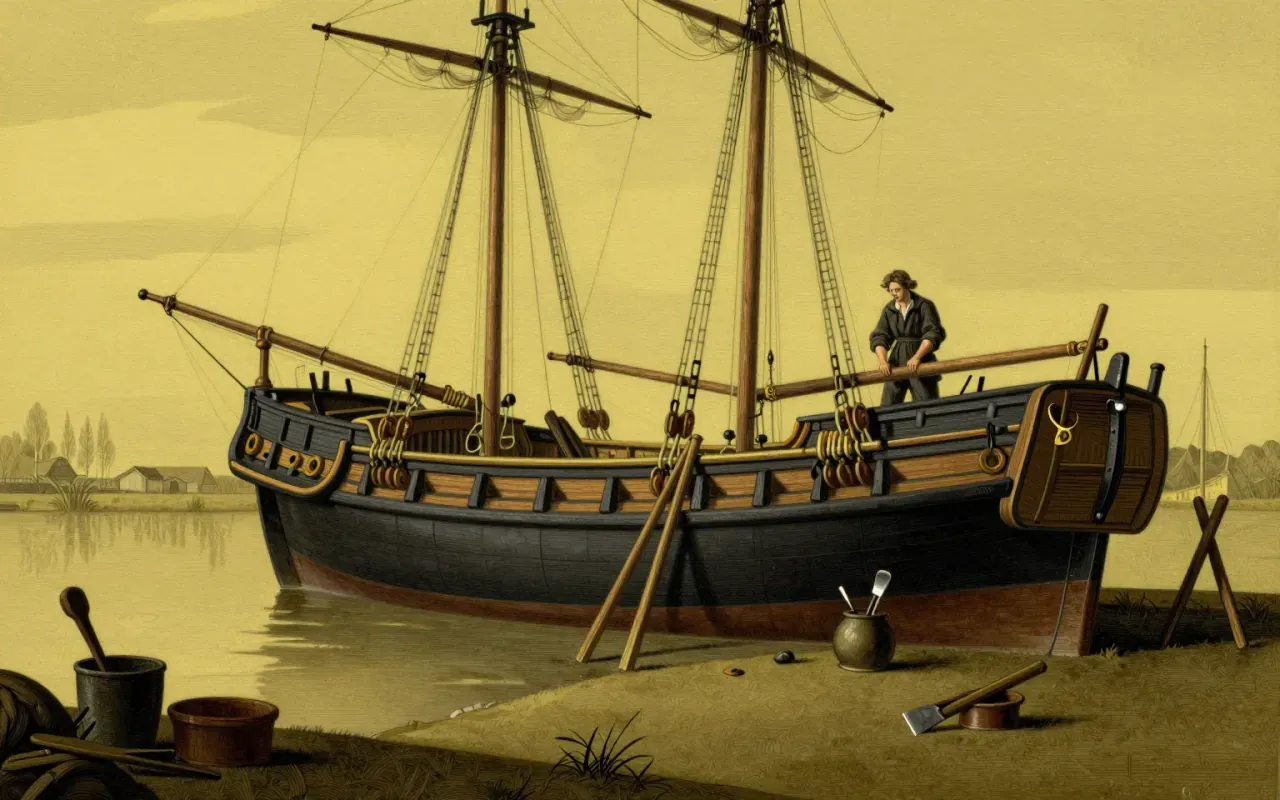
Peter ruled Russia jointly with his half-brother Ivan V from 1682, alone as tsar from 1696, and as the country’s first emperor from 1721 until his death on 8 February 1725. In March 1697 he set out incognito on an eighteen-month Grand Embassy through the Dutch Republic, England and German territories, working for four months at a shipyard of the Dutch East India Company in Amsterdam and inspecting naval facilities at Deptford and Woolwich in England, where he lodged at diarist John Evelyn’s estate. The mission’s stated diplomatic purpose, building an anti-Ottoman coalition, largely failed given European preoccupation with the coming War of the Spanish Succession, though the journey reshaped Peter’s own ambitions for Russia.
A trip meant for alliances that mostly built ambition instead
On his return in 1698, Peter faced a second Streltsy uprising, already suppressed by General Patrick Gordon before his arrival, and responded with mass torture and execution: an estimated 1,182 rebels were killed, their bodies displayed publicly as a warning, and the Streltsy corps was permanently disbanded. He went on to found St Petersburg on 29 June 1703 during the ongoing Great Northern War, banning stone construction elsewhere in the country to concentrate labour and materials on the new city, and moved the capital there from Moscow in 1712, a status it retained until 1918, building it with foreign architects into what one contemporary observer called a window facing the West.
A capital built on marshland to force a westward turn
Peter’s territorial ambitions centred on the Great Northern War against Sweden, launched in 1700 to secure Baltic access. An early defeat at Narva in 1700 was reversed through years of reorganisation, culminating in the decisive Russian victory at Poltava on 27 June 1709, which broke Swedish King Charles XII’s campaign and, as later assessments put it, overturned prevailing assumptions about Russian military competence. The subsequent Treaty of Nystad secured Russian control of the eastern Baltic coast and underpinned Peter’s assumption of the imperial title in 1721, transforming the tsardom into a recognised European empire, though a separate 1710 to 1711 war against the Ottoman Empire ended badly, forcing Russia to surrender Black Sea ports it had captured decades earlier.
Modernizer and police-state builder, in the same reforms
Peter’s administrative reforms, including the 1711 Governing Senate, the 1722 Table of Ranks linking noble status to state service, and the founding of a Russian Academy of Sciences and a university in 1724, are credited with modernising Russian governance and education along Western lines. These changes were pursued alongside, and by the same authority as, what is described as a well-ordered police state built on surveillance and coercion, extending beyond the Streltsy to the suppression of later uprisings among the Bashkirs, the population of Astrakhan and participants in the Bulavin rebellion, a pattern that leaves the modernizing and repressive dimensions of his rule difficult to treat as separate strands of the same reign.
Nearly twelve hundred executions after a single uprising
The scale of the violence Peter used to secure his reforms is itself part of the documented record: beyond the roughly 1,182 executions following the 1698 Streltsy revolt, his broader approach to governance is described as aiming to transform subjects into educated and useful members of society with the explicit help of force and fear. His earlier military campaigns show a similar pattern of persistence despite heavy cost, including the failed 1695 assault on Azov followed by a successful renewed campaign the following year after building a new navy at Voronezh, establishing a template of setback followed by reorganisation and renewed, often costly, effort that recurs across his reign.
Worth reading for how inseparable the two halves really are
Peter’s reign is worth studying precisely because its two most commonly separated aspects, the modernizing reformer who built academies and a navy, and the autocrat who tortured nearly twelve hundred rebels and ran an intrusive police state, were not sequential phases but the same governing method applied consistently across four decades. Readers who arrive expecting either an uncomplicated westernizing hero or a straightforward tyrant will find the more useful account in how thoroughly those two readings depend on each other, since the scale of change Peter achieved in Russia’s institutions and military standing was inseparable from the coercion he used to force it through.