Founded under Gupta patronage
Nalanda was founded around 427 under the Gupta emperor Kumaragupta I, with a seal discovered at the site identifying a ruler named Shakraditya as its founder, and the institution expanded steadily through the fifth and sixth centuries under successive Gupta patrons including Budhagupta and Baladitya, who added further monasteries and temples to the complex. It reached its documented peak in the seventh century, a period known largely through the accounts of Chinese Buddhist pilgrims who travelled there specifically to study, most notably Xuanzang, who arrived in 637 and remained for roughly two years studying under the institution’s senior teacher, Shilabhadra.
A pilgrim who broke the law to get there
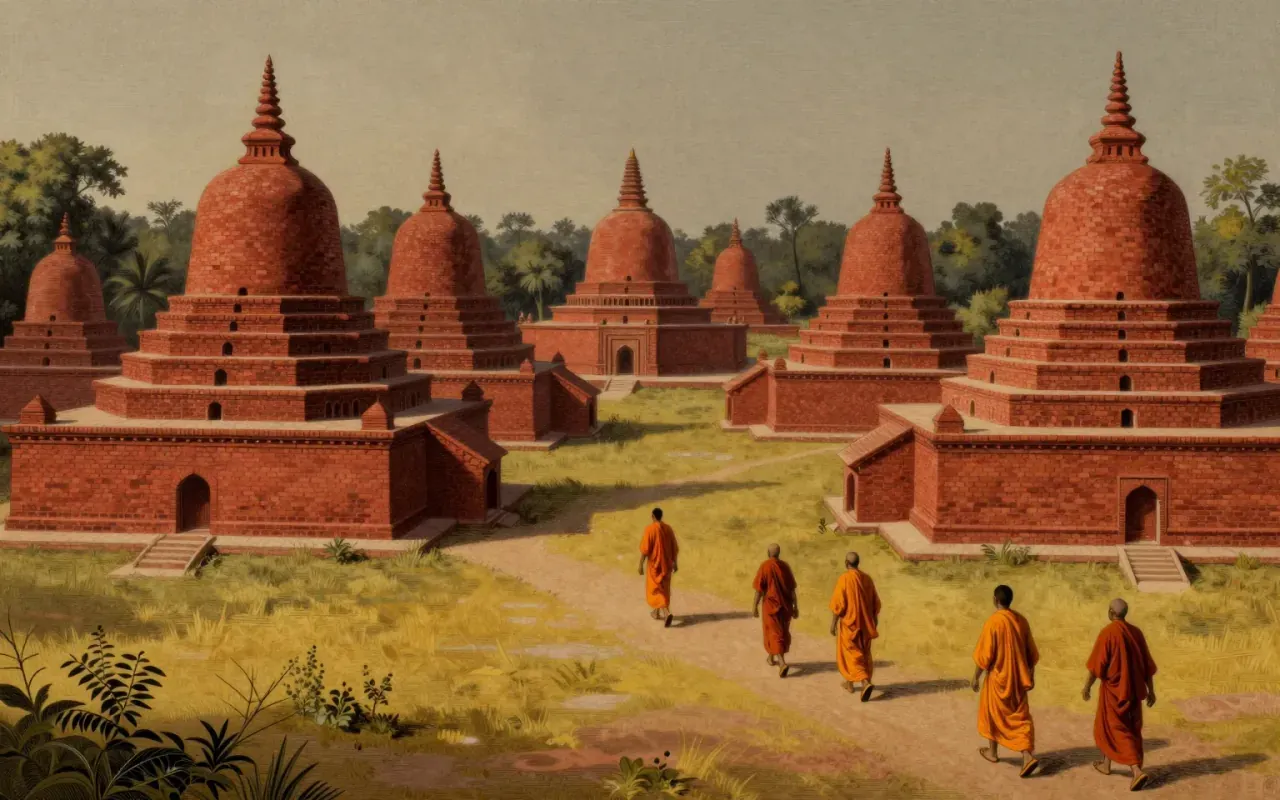
Much of what is known about Nalanda’s scale and daily functioning comes directly from Xuanzang’s own travelogue, since he recorded that revenue from a hundred surrounding villages supported the institution, which maintained more than 1,500 faculty members within a walled complex he described as featuring richly adorned towers rising above the clouds. This account is treated by historians as a valuable but not unimpeachable source, since Xuanzang’s broader travel writing is understood to mix genuine firsthand observation with hearsay and clearly legendary material, meaning scholars use his specific, checkable details, such as institutional scale and revenue, with more confidence than his more embellished descriptive passages.
A source that mixes fact with legend
Xuanzang’s presence at Nalanda was itself remarkable: he undertook his journey at age twenty-seven in direct defiance of a Chinese government travel ban, spending roughly sixteen years travelling through Central Asia and the Indian subcontinent before returning home around 645 with 657 Sanskrit texts carried on a caravan of twenty packhorses. A later pilgrim, Yijing, followed decades afterward, staying at Nalanda for ten years between 673 and 695 and collecting a further four hundred texts, together giving historians two independent Chinese eyewitness perspectives on the institution separated by several decades, allowing some comparison of how it changed over that interval.
Fifteen hundred faculty, a hundred villages of revenue
Modern historians treat Xuanzang’s writing with real caution precisely because it functions as what scholars call a terminus ante quem, establishing that certain people, texts and events existed by 645 at the latest, while the specific details he provides about them remain individually disputed and require corroboration where possible from other sources. This scholarly caution matters because Nalanda’s institutional history depends so heavily on this single detailed outside account, meaning any systematic bias or embellishment in Xuanzang’s reporting could distort modern understanding of the institution’s actual scale and character if taken entirely at face value rather than weighed critically.
A shift in Buddhist practice before the end
Under the Pala dynasty, which ruled from around 750 to 1200, Nalanda continued to thrive even as newer institutions such as Vikramashila emerged as competitors, though the Palas’ growing preference for Vajrayana Buddhism over the traditional Mahayana teaching that had defined Nalanda gradually shifted the institution’s religious character. The end came around 1200, when forces under Muhammad Bakhtiyar Khalji attacked and burned the complex, an event confirmed archaeologically through thick layers of ash found at the site, though Tibetan records indicate some monks escaped and reduced scholarly activity persisted at a smaller scale for some years afterward rather than the institution disappearing instantly.
Burned, but not instantly extinguished
This is valuable reading specifically for how transparently it handles its central source’s limitations, treating Xuanzang’s travelogue as genuinely useful evidence while being explicit that parts of it blend into legend rather than reliable reporting. It rewards attention for that critical handling of a foundational text. It has less to offer if you want a precise account of exactly how long reduced scholarly activity continued at the site after its destruction, a period the record acknowledges without pinning down in detail. Readers wanting a firmer chronology for that gradual afterlife, rather than the institution’s dramatic founding and destruction, will find the material thinner on that specific stretch of its history.