An empire at its height
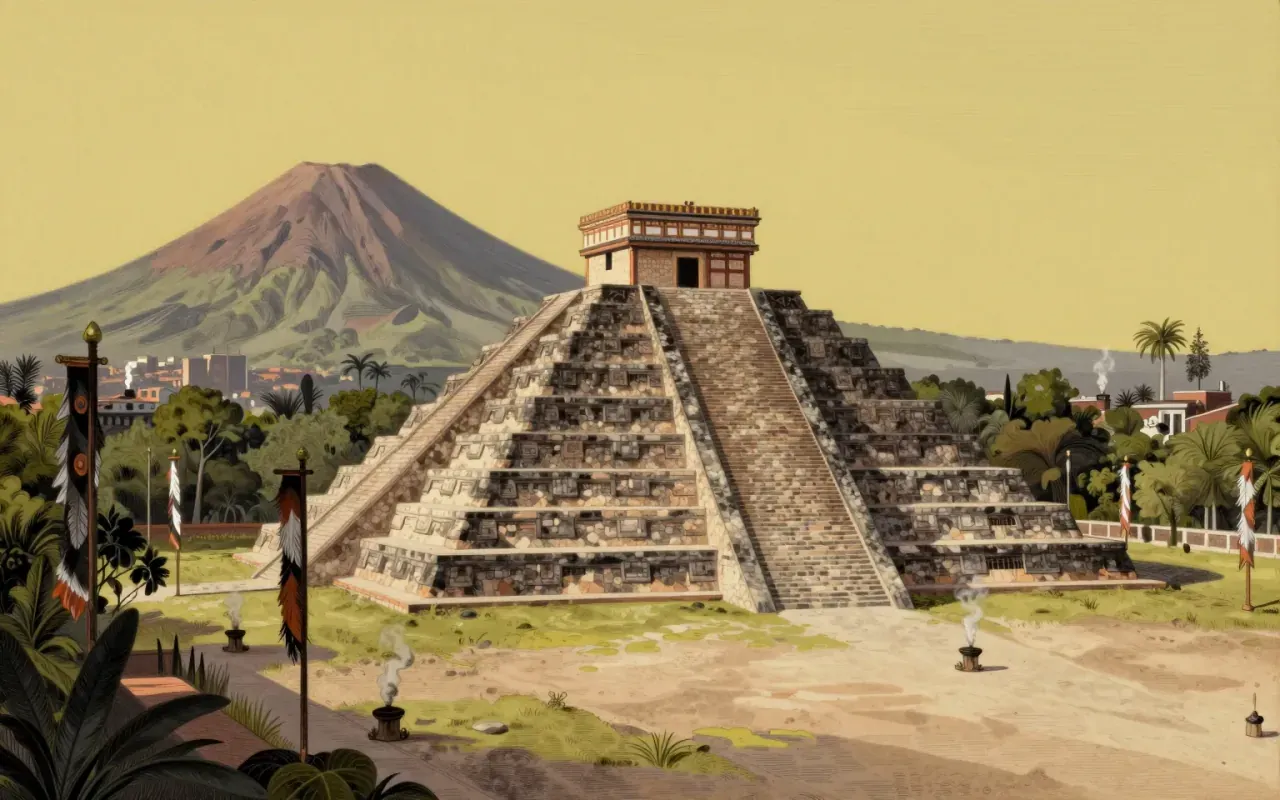
Born around 1466 to Emperor Axayacatl, Moctezuma II trained at an elite school for nobles, distinguished himself as a warrior, and was crowned the ninth Aztec emperor around 1502 or 1503. He led or directed some seventy-three military campaigns over his reign, winning roughly forty-three, expanded the empire to its greatest territorial extent, reaching south into Chiapas and the Isthmus of Tehuantepec, and centralised administration by dividing his territory into thirty-eight provinces run by appointed officials. He also widened the gap between nobility and commoners by barring commoners from palace service, a departure from earlier, more meritocratic Aztec practice. Spanish forces under Hernan Cortes reached his capital, Tenochtitlan, in November 1519 and were received peacefully, but relations deteriorated over the following months, and Moctezuma died on 29 June 1520 amid violent unrest in the city, during the same turbulent period that would soon end in the empire’s fall to Spanish and allied forces the following year.
Sources with opposing interests
Moctezuma’s reign is documented through a genuinely mixed set of sources whose perspectives diverge sharply depending on their origin. Spanish eyewitnesses, chiefly Cortes himself and the soldier Bernal Diaz del Castillo, generally portrayed him as weak-willed, superstitious and indecisive, a characterisation that conveniently justified Spanish actions by suggesting minimal Aztec resistance to overcome. Indigenous and mixed-heritage chroniclers offer a more divided picture: pictorial records including the Codex Mendoza and the Duran Codex document his military campaigns and palace directly, Bernardino de Sahagun’s Florentine Codex preserves an indigenous-informed account, and the colonial-era Nahua historian Fernando de Alva Ixtlilxochitl produced narratives modern historians explicitly flag as unreliable, since much of his material contradicts other, better-supported sources. The underlying record itself acknowledges that accounts of Moctezuma’s policies were shaped by propaganda both for and against him, meaning even his most basic administrative decisions come filtered through writers with a clear stake in how he should be remembered.
Centralising in success
Moctezuma’s policy of restricting palace service and privilege more tightly to hereditary nobility, breaking from his predecessors’ comparatively more open practice, reflected a ruler consolidating personal and dynastic authority at the height of the empire’s power, when territorial expansion had brought enough tribute and prestige that centralising control more firmly around an established elite may have seemed a natural extension of that success rather than a risk. His extensive administrative reforms, dividing the empire into provinces under centrally appointed officials, mirror similar centralising strategies pursued by other successful pre-modern empires facing the logistical challenge of governing conquered territory at real distance from the capital. When Spanish forces arrived, Moctezuma’s initial choice to receive Cortes peacefully rather than resist by force, whatever the precise mixture of caution, uncertainty about the newcomers’ intentions and miscalculation of the actual threat they posed, reflected decisions made by a ruler operating without any prior precedent for encountering a genuinely unfamiliar foreign power of this kind.
A death no source agrees on
No question about Moctezuma generates sharper disagreement than how he actually died, with Spanish accounts claiming he was stoned by his own outraged subjects while attempting to calm a hostile crowd and other, indigenous-derived testimony instead holding that Spanish soldiers killed him directly, a contradiction the surviving sources simply do not resolve. His overall character and competence are judged just as differently depending on the source consulted: Spanish writers overwhelmingly describe a weak and superstitious ruler who surrendered without serious resistance, while indigenous accounts split between portraying him as one of the greatest leaders Mexico had produced and, elsewhere, as a tyrant obsessed with consolidating absolute personal control. A related dispute concerns the death of the allied ruler Nezahualpilli and Moctezuma’s role in securing a favoured successor afterward, with the unreliable chronicler Ixtlilxochitl calling the episode diabolical, a characterisation modern historians treat with scepticism given his broader unreliability elsewhere in the record.
A reign overwritten by its ending
Moctezuma presided over the Aztec Empire at its greatest territorial extent, and his consolidation of noble privilege outlasted his own reign and even the empire’s fall, since Spanish colonial administrators found it convenient to preserve the distinction between noble and commoner status among indigenous subjects, letting pre-conquest elites retain certain privileges under the new Viceroyalty of New Spain that ordinary commoners did not share. His death left the empire without effective leadership at precisely the moment it most needed unified resistance, and the two rulers who briefly succeeded him before Tenochtitlan’s fall in 1521 could not reverse the collapse already underway. His reign has since become one of the most widely recognised points of contact between indigenous American and European civilisations, a status owed less to any policy achievement than to the historical weight of what happened at its end, ensuring his name remains permanently linked to the conquest rather than to the decades of successful rule that preceded it.
No settled portrait available
Moctezuma is worth engaging with as a case study in how a single dramatic ending can permanently overwrite decades of otherwise successful rule in popular memory, since a ruler who expanded his empire to its largest extent and reorganised its administration is remembered chiefly for the manner and disputed circumstances of his death. Readers should treat the Spanish characterisation of him as weak and superstitious with real scepticism, given how directly that portrayal served the interests of the very people recording it, while also recognising that indigenous sources offer no single unified alternative verdict to replace it with. Anyone interested in how conquest narratives shape the reputation of a defeated ruler, in the mechanics of imperial administration in Mesoamerica, or in the genuine difficulty of recovering a balanced picture from sources this thoroughly shaped by competing interests will find Moctezuma a rewarding subject, provided they accept that no fully settled portrait of the man is actually available.