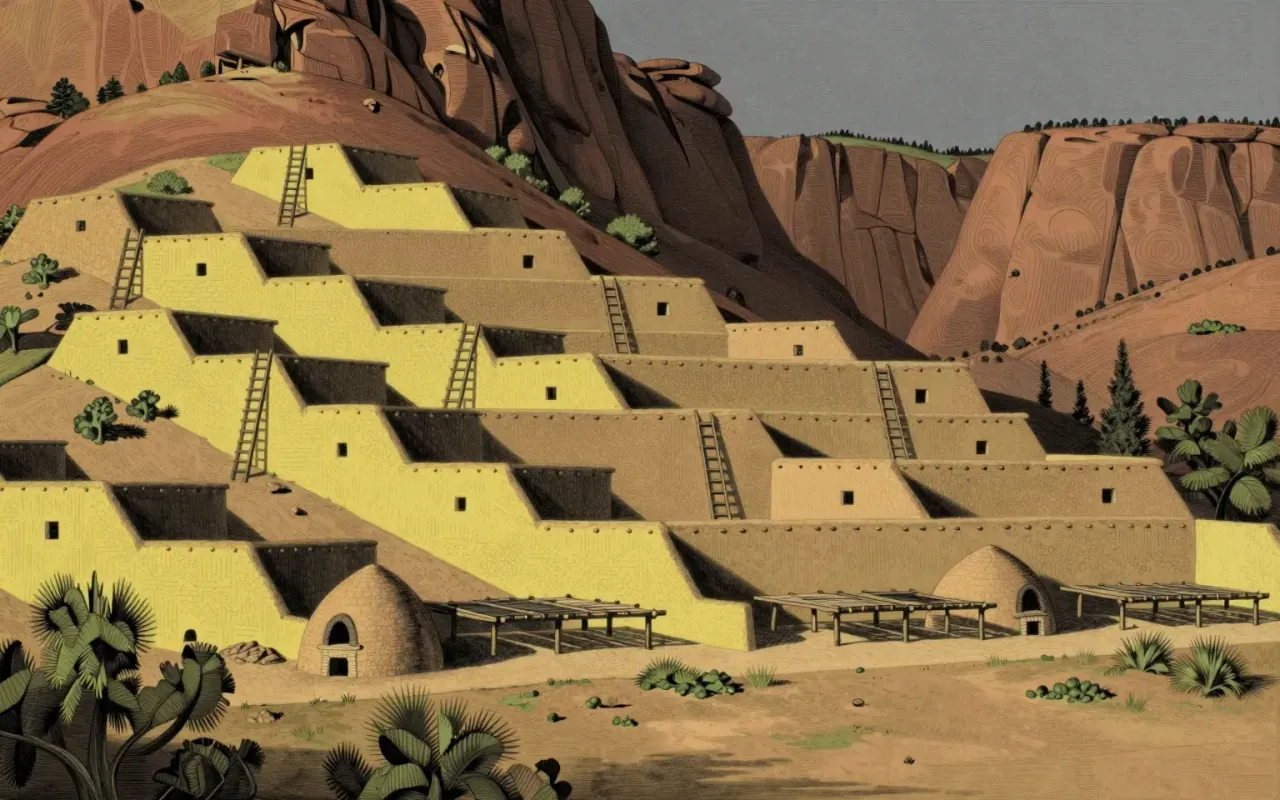
A coordinated uprising
In August 1680, Pueblo communities across Spanish New Mexico rose in coordinated revolt after five years of planning by Po’pay, a Tewa religious leader who had been publicly whipped in 1675 for practising traditional ceremonies the Spanish colonial authorities had banned. Runners carried knotted cords to signal the date, and when two messengers were captured on 9 August the uprising began a day early rather than risk exposure. Within days Pueblo forces had destroyed outlying Spanish settlements and besieged the colonial capital of Santa Fe, killing some four hundred Spaniards, including twenty-one of thirty-three resident Franciscan missionaries, while losing over six hundred of their own. Governor Antonio de Otermin led the roughly two thousand Spanish survivors in retreat south toward El Paso by late August, leaving Pueblo communities in control of the province for twelve years, until Spanish forces under Diego de Vargas returned and reasserted control in 1692.
A record from the losing colonists
Spanish colonial records, including Governor Otermin’s official letters and reports sent back to the crown, supply most of the immediate documentary evidence for the revolt’s course, naturally emphasising Spanish suffering and loss. Pueblo perspectives survive more indirectly, through oral tradition preserved and later documented by tribal historians, and through testimony some Pueblo people gave to returning Spanish authorities during the 1691 to 1692 period, when accounts of what had happened during the intervening years were recorded by the very colonial administration whose earlier expulsion they described. One recorded detail illustrates the gap between the two traditions directly: when questioned about the revolt’s leadership, captured Pueblo men reportedly gave the names of deities rather than actual organisers, a response historians read as either genuine religious framing of the uprising or a deliberate strategy to protect Po’pay and other real leaders from Spanish retaliation.
Coordination over confrontation
The revolt succeeded where earlier, more localised acts of resistance had failed chiefly because Po’pay spent years building coordination across pueblos separated by roughly four hundred miles of territory and speaking several different languages, a logistical achievement that let dozens of otherwise independent communities rise simultaneously rather than piecemeal, when Spanish forces might have suppressed them one at a time. Spanish colonial rule had also accumulated genuine grievances well beyond religious suppression alone, including forced labour demands and periods of drought and famine that colonial administration had done little to ease, giving the uprising a base of support that extended past Po’pay’s own immediate religious followers. The numerical imbalance between a Spanish colonial population of a few thousand, many of them not combat-ready settlers, and a Pueblo population still numbering in the tens of thousands despite decades of decline, meant that once genuinely unified action became possible, Spanish military superiority in equipment could not compensate for being so heavily outnumbered.
A leader known through his enemies
Historians disagree on several points, starting with Po’pay himself, whose character comes down through hostile Spanish chroniclers and the Native informants those chroniclers relied on, most of whom opposed him, leaving open real questions about whether he governed the reunified pueblos afterward as a unifying visionary or, as some surviving testimony suggests, as a demanding ruler who provoked resentment even among people he had helped liberate. Even the date of his own death is disputed, with some sources placing it around 1688 and others closer to 1692, shortly before the Spanish return. Whether the revolt primarily reflected religious revitalisation or more straightforward political and economic grievance against colonial exploitation remains debated, since the surviving evidence supports both readings without clearly favouring one. A further disagreement concerns horses: some historians credit the revolt with spreading horse culture onto the Great Plains once Spanish livestock was seized, while genetic and archaeological evidence suggests horse culture there was already established beforehand.
Concessions that lasted
When Spanish forces returned in 1692, they did not simply restore the previous colonial order. Franciscan missionaries abandoned earlier efforts to fully suppress traditional Pueblo religion, allowing it to continue alongside Catholic practice rather than attempting the outright theocratic control that had provoked the original revolt, and colonial authorities granted substantial land protections and appointed officials specifically tasked with defending Pueblo legal rights against settler encroachment. The harsh encomienda labour system that had driven much of the original grievance was not reinstated in its earlier form. Historians now describe the uprising as the earliest documented instance of a Native American religious revitalisation movement, a template later resistance efforts across the continent would echo in different forms. Some displaced communities also permanently relocated during and after the conflict, with the Picuris eventually joining Apache groups as far away as present-day Kansas, spreading Pueblo cultural influence well beyond the immediate region the revolt had originally freed.
A template for resistance
The Pueblo Revolt deserves recognition as the most successful sustained indigenous resistance to European colonisation anywhere in the Americas, a fact often overshadowed in popular historical memory by conquests that ended the opposite way. Readers should approach Po’pay himself with appropriate caution, since almost everything recorded about him passed through the hands of people who either feared or actively opposed him, leaving the historical record with a genuinely uncertain picture of what kind of leader he actually was once in power rather than in revolt. The revolt’s lasting effect on Spanish colonial policy, a real and durable shift away from attempted religious eradication toward a more negotiated coexistence, offers a rare example of successful resistance producing concrete, lasting institutional concessions rather than mere temporary victory followed by full reconquest and reversal. Anyone interested in indigenous North American history, in religious revitalisation as a political strategy, or in genuinely successful anti-colonial resistance will find this an unusually rewarding case.