A royal estate, not a lost city
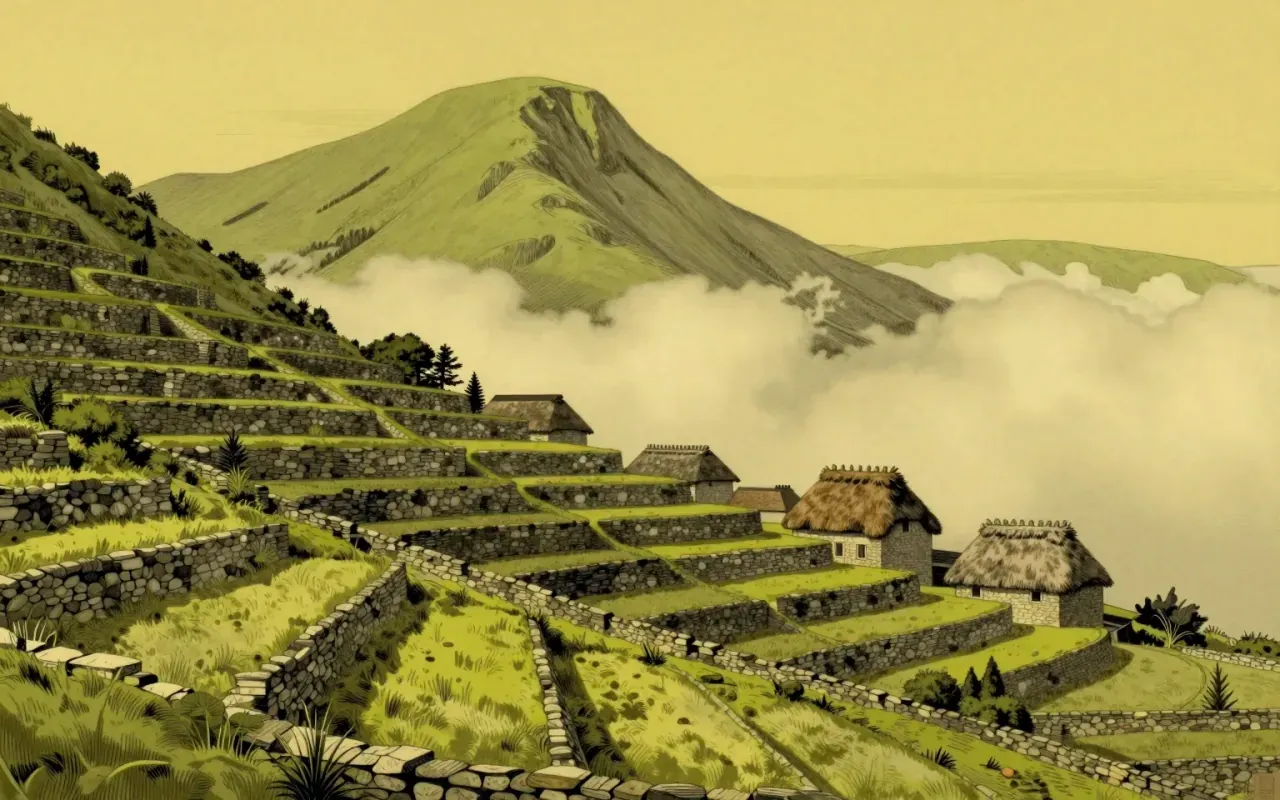
Machu Picchu is generally understood as a royal estate commissioned by the Inca ruler Pachacutec following his conquest of the Urubamba river region, part of a broader pattern of establishing such estates along the valley, with construction traditionally dated to around 1450 and continuing under his successor Tupac Inca Yupanqui. Radiocarbon analysis conducted in 2021, however, suggested occupation may have begun as early as 1420, moving the site’s origins earlier than long assumed. The estate housed a seasonal population of roughly seven hundred and fifty people, primarily support staff known as yanaconas, before being abandoned around the mid-sixteenth century, likely due to the disruption and disease accompanying the Spanish conquest rather than direct Spanish military action at the site itself.
Dating pushed back by science
Genetic analysis of remains found at the site has revealed a notably diverse population, with individuals originating from coastal, Andean, Ecuadorian and Amazonian backgrounds, indicating the estate drew its workforce from across a wide span of the Inca Empire rather than from a single local population. Systematic archaeological research between 2014 and 2017 refined understanding of the site’s construction phases and population estimates, while laser scanning conducted by the University of Arkansas in 2005 and 2009 produced detailed three-dimensional records supporting further research, and pollen studies have helped trace how the site’s central plaza evolved from a natural drainage basin into a deliberately constructed ceremonial space across multiple building phases.
A workforce drawn from across the empire
The site’s rediscovery is a case study in how credit for a historical find can shift considerably from the actual first documented visitor: a Peruvian farmer, Agustin Lizarraga, reached the ruins in 1902 and left his name inscribed at the Temple of the Three Windows, nine years before the American historian Hiram Bingham arrived in 1911 and found that same inscription. Bingham initially acknowledged Lizarraga as the site’s discoverer in his 1922 publication, but by his 1952 book he claimed primary discovery for himself, justifying the shift in a contemporaneous letter by arguing that the site had not been known to geographical and historical societies before his own report on it, regardless of who had physically reached it first.
Discovered first by someone else
Interpretation of the site’s specific purpose remains genuinely unsettled: Bingham himself proposed several hypotheses during his lifetime, none of which subsequent research has substantiated, and even individual structures within the complex continue to generate disagreement, most notably the Intihuatana stone, long popularly described as a precise solar calendar, an interpretation recent archaeoastronomical study has specifically rejected in favour of a broader ritual solar orientation rather than a functional astronomical instrument. A 2021 study further suggested that the site’s own original name may have been Huayna Picchu or simply Picchu, with the name Machu Picchu becoming attached to the ruins only after Bingham’s own publications popularised it.
A discoverer’s story that hardened over time
Bingham’s excavations between 1912 and 1915 removed thousands of artefacts to Yale University, a decision that later drew accusations from Peru of cultural appropriation, though Bingham had operated within Peru’s own 1852 legal code, which permitted archaeological finds on non-private land to belong to their discoverers. Yale retained most of these artefacts for a century, finally returning the last batch in 2012. The site is now a UNESCO World Heritage location receiving more than 1.5 million visitors annually, a scale of tourism that has created ongoing preservation challenges and disputes over proposed infrastructure development at the site.
Even its stones are still being reinterpreted
This is a rich subject precisely because it complicates two things people usually take for granted, who actually discovered the site and what the ruins were originally built for, with specific documented evidence rather than vague caveats. It rewards attention for the Bingham-Lizarraga discovery story alone. It offers less certainty on the site’s precise original name and the exact ceremonial function of key structures, both of which remain live, unresolved questions in current scholarship rather than settled facts. Readers wanting a confident final answer on either point should expect the material to lay out competing possibilities rather than settle on one, which is itself a fair reflection of where the research currently stands.