A civil war won, a Chinese-style dynasty founded
Kublai Khan, born in 1215 as a grandson of Genghis Khan, was proclaimed Great Khan by his own assembled council in April 1260 after his brother Mongke’s death, a claim contested by another brother, Ariq Boke, until Kublai’s victory in the resulting civil war on 21 August 1264. In 1271 he formally founded the Yuan dynasty, moving the Mongol capital from Karakorum to Khanbaliq, modern Beijing, and positioning himself within Chinese imperial tradition. His forces completed the conquest of the Southern Song dynasty by 1279, when the last Song emperor died at the naval Battle of Yamen, making Kublai the first non-Han ruler to control all of China.
A reign recorded by Chinese scribes, Mongol chroniclers and a Venetian merchant
Kublai’s reign is documented from several distinct vantage points. Chinese sources emphasised his adoption of Confucian governance and framed him as restoring civilised imperial order, reflected in the elaborate Chinese-style title conferred on him. Mongol chronicles instead stressed his role as Khagan and guardian of Mongol unity, recording the suspicion of traditionalists who worried his adoption of Chinese customs betrayed the old ways of the Mongol Empire. A further, distinctive source comes from the Venetian merchant Marco Polo, who served in Kublai’s administration for roughly seventeen years from the 1270s onward and gave Europeans their most detailed contemporary account of the wealth and organisation of the Yuan court.
Governing two peoples who each doubted his loyalty to them
Kublai’s governance combined genuinely contradictory elements. He built an academy, sponsored science and the arts, rebuilt the Grand Canal, and established over 20,000 public schools, while relying on a mix of advisors including Han Chinese officials, a Sakya Buddhist lama, and Muslim administrators such as Sayyid Ajjal Shams al-Din Omar. At the same time, he favoured Buddhism over Taoism strongly enough to force the conversion of 237 Taoist temples, restricted Han Chinese political influence after 1276 following an earlier revolt, and retained distinctly Mongol religious and legal practices, a balancing act that left both Chinese subjects and Mongol traditionalists only partially satisfied with his rule.
A currency innovation, an eventual inflationary collapse
Among Kublai’s more distinctive innovations was the widespread issue of paper currency, the jiaochao, beginning in 1260, making him one of history’s earliest large-scale users of fiat money backed by government decree rather than precious metal. This system functioned effectively for a period but ultimately succumbed to a lack of fiscal discipline, and the resulting inflation became one of the contributing factors in the broader instability that affected the Yuan dynasty in the years following Kublai’s own reign, illustrating how a genuinely forward-looking financial innovation could still fail without the institutional restraint needed to sustain it.
A fleet built in one year for a job that needed five
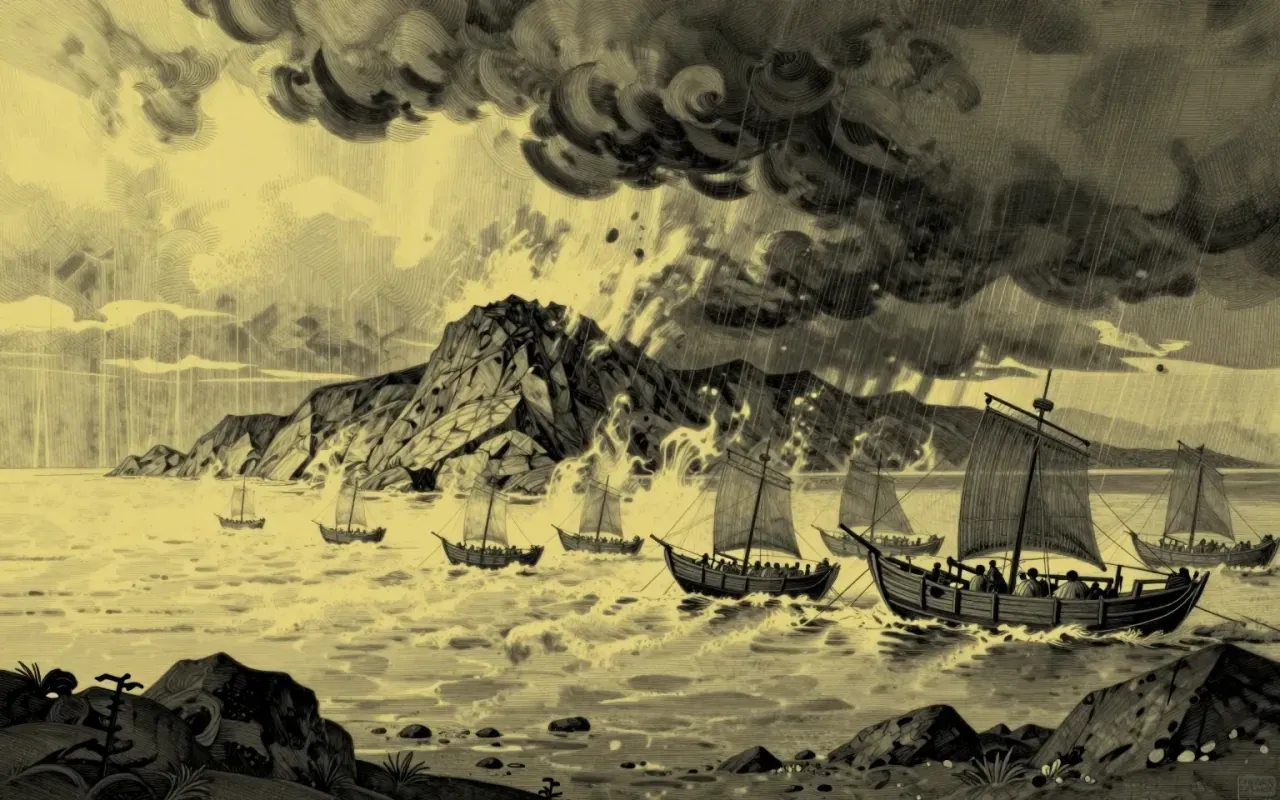
Kublai’s two invasions of Japan both ended in failure: the first, in 1274, involved roughly 900 ships that were repelled partly due to design flaws in vessels better suited to river use than open sea, and the second, in 1281, involved a considerably larger force of about 140,000 troops in 4,400 ships that Japanese defenders repulsed at Hakata Bay, inflicting an estimated 3,500 casualties. Archaeologist Kenzo Hayashida has argued that Kublai attempted to construct this enormous invasion fleet in roughly one year, a task that would normally have required up to five, forcing reliance on hastily and inadequately built ships, an explanation that complicates the popular legend crediting the invasion’s failure primarily to a providential storm.
Worth reading for the balancing act that never fully succeeded
Kublai Khan’s reign rewards close study precisely because it captures, in unusual documented detail, the difficulty of ruling two fundamentally different populations, Mongol and Chinese, under a single system without either fully accepting him as their own. Readers drawn to his dramatic territorial reach, from Beijing to a nearly successful invasion of Japan, gain the most from tracing the specific tensions underneath that reach: a currency system innovative enough to anticipate much later financial practice yet undone by simple lack of discipline, and a military ambition large enough to attempt conquering Japan twice yet undermined, according to the archaeological record, by rushed construction rather than divine intervention alone.