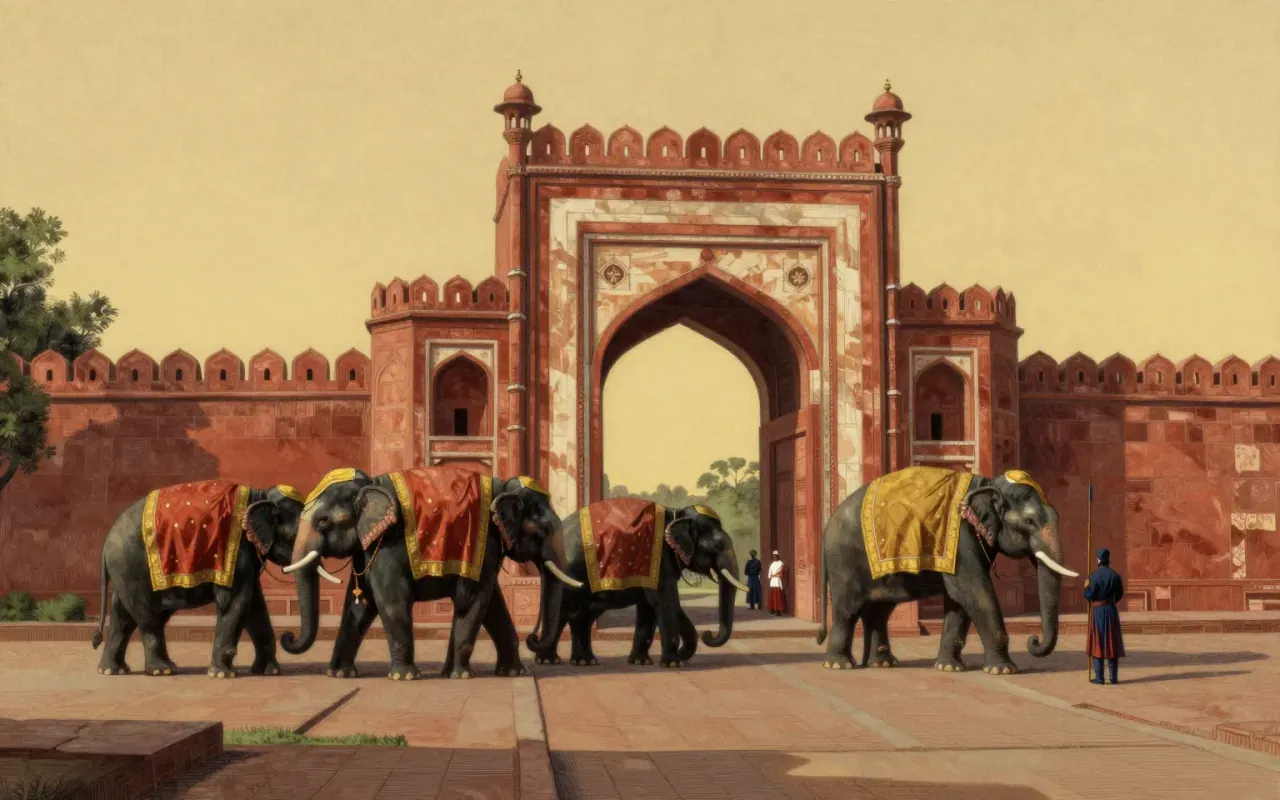
A fourteen-year-old king who conquered from Bengal to Kabul
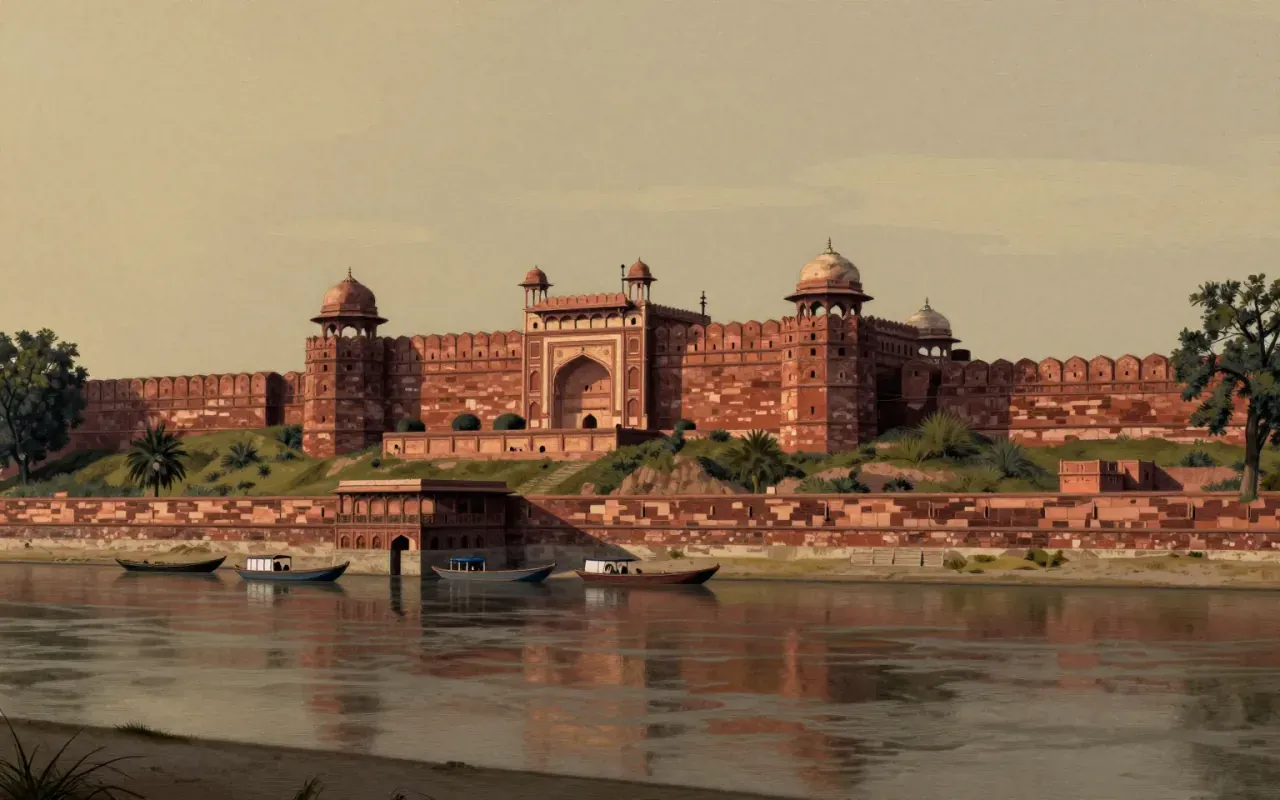
Akbar came to the Mughal throne on 14 February 1556 at age fourteen, under the regency of Bairam Khan, and secured his hold on Delhi and Agra that same year by defeating Hemu at the Second Battle of Panipat. Over the following decades his campaigns absorbed Gujarat in 1572 and 1573, Bengal by 1576, Kabul in 1581, Kashmir in 1589 and territory in the Deccan by 1601, along with a costly four-month siege of the fortress of Chittorgarh in 1567 and 1568 in which a large number of non-combatants are recorded as having been killed. By his death in 1605 the empire he controlled stretched from the Bay of Bengal to Kandahar and Badakhshan.
A reign known mainly through the minister who was paid to praise it
Much of the detailed narrative of Akbar’s reign comes from the Akbarnama, written between 1590 and 1595 by his own courtier Abul Fazl as an official history intended to glorify his patron’s achievements. That origin means its claims, including Akbar’s own dispatches describing the Chittorgarh campaign as a victory of Islam over unbelief and reporting the destruction of temples, are read by modern historians as reflecting the religious and political rhetoric expected of the era’s court literature rather than as a neutral battlefield record. Because so much of what is known about Akbar’s stated motives and self-presentation passes through this one carefully composed source, historians treat its more flattering claims with deliberate caution.
Taxes lifted, marriages reformed, a system built to hold a diverse empire
Akbar built an administrative structure known as the mansabdari system, ranking military and civil officials by assigned cavalry numbers, with the highest ranks reserved for princes, and paired it with a revenue system, developed with his minister Raja Todar Mal, that calculated obligations as one-third of a location’s average production over the preceding ten years, paid in cash. He also abolished the jizya, a tax previously levied on non-Muslim subjects, and reversed prior court practice regarding Rajput noblewomen who married into the imperial family, allowing them to retain equal court status and continued ties to their birth families rather than disappearing into the harem as earlier practice had dictated, strengthening alliances with Rajput nobles including Raja Bharmal’s family.
A famous loyalty legend traced back to a much later chronicle
A specific instance of source criticism concerns the celebrated statues at Agra commemorating two Rajput defenders, Jaimal and Patta, said to have died heroically defending Chittorgarh against Akbar’s siege. The historian Eugenia Vanina’s research found no evidence connecting these figures to the actual 1568 siege in sources contemporary to the event, with the earliest such connection appearing only in a Dutch chronicle written more than sixty years later, suggesting the legend developed afterward to provide a shared narrative justifying the later Mughal-Rajput alliance rather than recording a documented act from the siege itself, a finding that illustrates how much of Akbar’s popularly remembered reign rests on stories assembled after the fact.
A new faith for the court, a tax abolished for everyone else
Akbar’s later religious policy moved toward an explicitly syncretic court faith, described as drawing chiefly on Islam and Hinduism with elements of Zoroastrianism and Christianity, promoted alongside continued patronage of Sanskrit translation and education open to both Muslim and Hindu students. Combined with the jizya’s abolition and the reformed Rajput marriage practice, this produced a court and administration that incorporated non-Muslim elites more fully than earlier Mughal or Delhi Sultanate practice had allowed, a shift modern historians generally read as pragmatic statecraft aimed at securing a diverse and religiously varied empire rather than as personal religious conviction alone, though the two motivations are not easy to fully separate.
Worth reading with the court chronicler’s motives in mind
Akbar’s reign rewards close attention precisely because so much of its most vivid detail, from his own justifications for conquest to the loyalty legends attached to his Rajput rivals, was shaped or invented by writers working after the fact with their own reasons for telling the story a particular way. Readers who already know Akbar as history’s model of enlightened Mughal tolerance gain the most from seeing how that reputation was built, partly on genuine administrative innovation and religious accommodation, and partly on a court chronicle and later legends whose specific claims modern historians have had to test rather than simply accept.