No warning, unlike the year before
The earthquake that destroyed much of Tangshan struck at 3:42 and 55 seconds in the morning on 28 July 1976, registering a magnitude of 7.6, with a secondary shock of magnitude 7.0 following that afternoon near Luanxian, roughly seventy kilometres away. What made the main shock especially devastating was the complete absence of perceptible warning: unlike the Haicheng earthquake of the previous year, which had been successfully predicted in advance thanks to extensive foreshock activity, Tangshan gave no comparable precursory signals, leaving residents with no opportunity to evacuate or take shelter before the ground began to shake in the middle of the night, when almost the entire population was indoors and asleep.
A warning that was raised, then set aside
A warning of sorts had in fact been raised shortly beforehand. Seismologist Wang Chengmin cautioned, about a week before the earthquake, that activity of magnitude five or greater was possible in the Tangshan-Luanxian area sometime between 22 July and 5 August. This warning did not translate into public action, however, partly because of internal disagreement within China’s State Seismological Bureau, where some officials argued instead that a major earthquake was more likely in western China, and partly because of concern that issuing a public alert risked causing unnecessary alarm if the prediction proved wrong. The absence of any actual foreshock activity before the quake itself meant that, even setting aside the bureaucratic hesitation, the specific method that had worked at Haicheng offered little additional traction at Tangshan.
A city of unreinforced brick, built on the fault
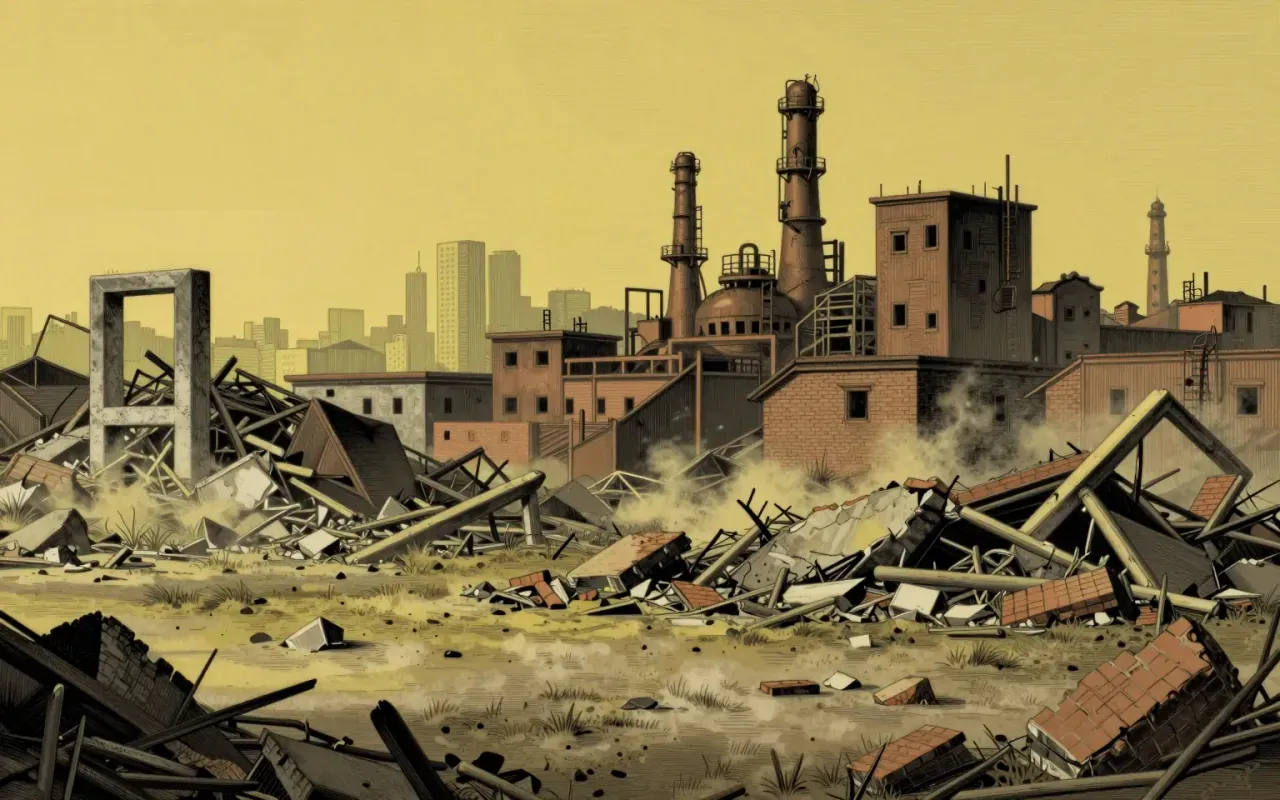
Tangshan’s vulnerability was compounded by its construction and its location. The city consisted mainly of unreinforced brick buildings, a construction style poorly suited to withstanding strong ground shaking, and it sat directly atop the Tangshan fault itself, a proximity that had not been adequately reflected in the seismic risk assessments applied to the city’s building standards beforehand. The result was catastrophic: an estimated 85 percent of Tangshan’s buildings collapsed or became unusable within minutes of the earthquake striking, essential services failed across the city, and most of the region’s highway and railway bridges collapsed as well, cutting off much of the area from easy outside access at precisely the moment that access was most urgently needed.
Two death tolls that never quite reconciled
China’s official government count places the earthquake’s death toll at 242,469, a figure that has stood as the country’s formal position since shortly after the disaster. Historians who have cross-checked internal government files argue the true toll was at least 300,000, pointing to an internal September 1976 report that cited 263,299 deaths nationally, 17,599 missing persons whose fates were never fully accounted for, and roughly 12,000 severely injured patients transferred elsewhere for treatment who never returned and were apparently not counted among the dead. Military casualties, recorded separately at 158 army and 522 air force deaths, were not disclosed publicly until years afterward, adding to the sense that the official figure represents a floor rather than a fully reconciled final count.
Rejecting help, then rebuilding fast
China’s initial response to the disaster combined genuine domestic capacity with a deliberate refusal of outside assistance. More than 42,000 workers were mobilised for emergency railway repairs, restoring the Tongxian-Tuozitou line by 3 August and the Beijing-Shanhaiguan line by 10 August, albeit initially at restricted operating speeds, a rapid organisational response given the scale of destruction to transport infrastructure. At the same time, the government declined offers of foreign aid, a decision reflecting both Cold War-era geopolitical caution and a broader ideological commitment to demonstrating socialist self-sufficiency in the face of disaster, even though accepting outside help might plausibly have eased the immediate humanitarian burden on survivors in the earthquake’s chaotic first weeks.
An earthquake that shook Mao’s mandate too
The earthquake landed at a politically fraught moment for China, striking just six weeks before Mao Zedong’s death on 9 September 1976 and during the final, unsettled phase of the Cultural Revolution. Traditional Chinese belief held that major natural disasters could signal a ruling authority’s loss of the mandate of heaven, a framework that added symbolic weight to the disaster’s timing regardless of whether officials at the time endorsed that interpretation directly. The earthquake also became a lasting reference point for Chinese seismology specifically, exposing real limitations in the country’s earthquake prediction methods so soon after the celebrated success at Haicheng, and prompting decades of subsequent debate within the scientific community about how reliable earthquake forecasting could realistically be expected to become.