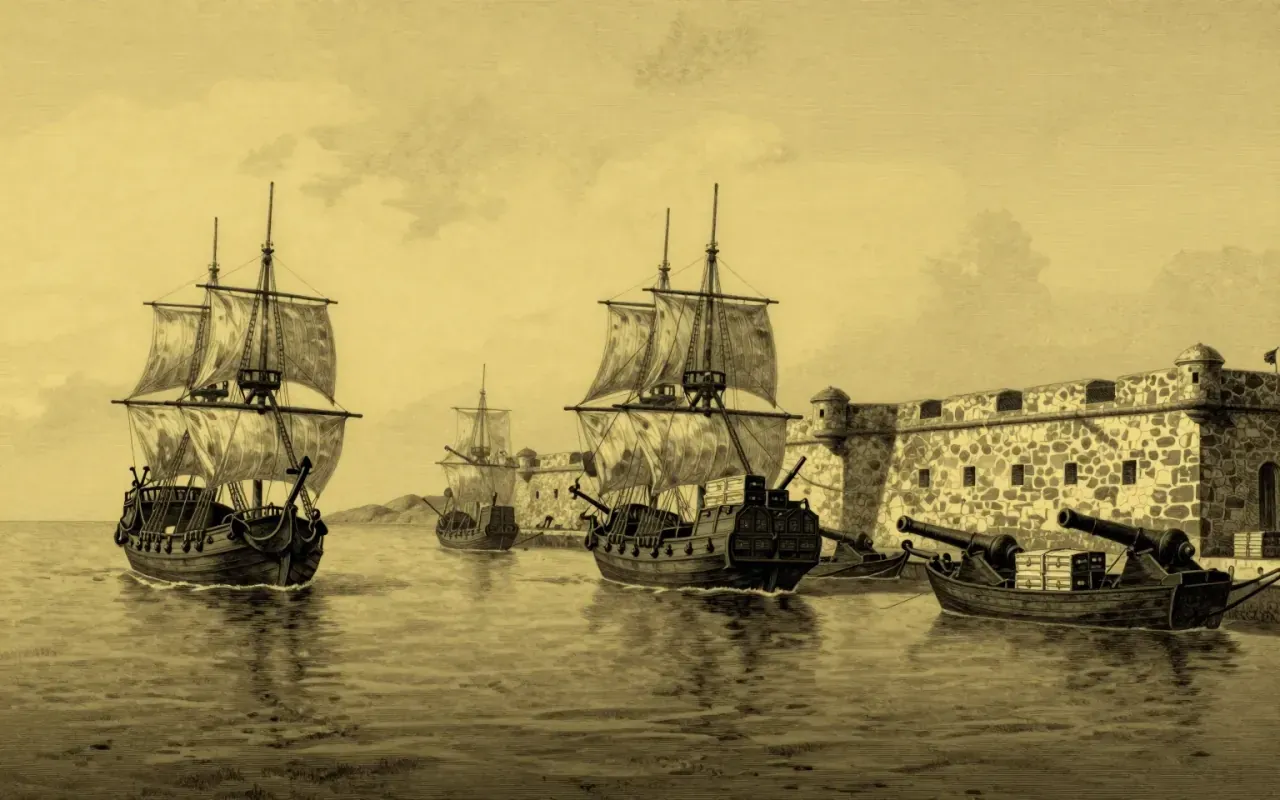
A dynastic union, then a hemisphere
The Spanish Empire formed from the 1469 marriage of Ferdinand of Aragon and Isabella of Castile, whose combined forces completed the reconquest of Granada in 1492, the same year Christopher Columbus’s Atlantic voyage opened the way to Spanish colonisation of the Americas. At its greatest extent, in the late eighteenth and early nineteenth centuries, the empire covered roughly 13.7 million square kilometres, spanning most of Central and South America and the Caribbean, parts of North America, territories in Africa and the Pacific including the Philippines, and, for periods, holdings in Italy and the Low Countries. This scale supported the description, common by the sixteenth century, of an empire on which the sun never set.
Bureaucratic records built for administration, not for verdicts
Spanish colonial administration generated extensive bureaucratic documentation through bodies including the Council of the Indies and the Casa de Contratacion, staffed by university-trained officials whose correspondence and reports form the main archival record of imperial governance. These records reflect an official, administrative viewpoint rather than an independent or indigenous one, and contemporary chronicles by figures such as Hernando del Pulgar documented voyages and conquests largely from the perspective of the conquerors themselves. Modern historians increasingly supplement this administrative archive with attention to indigenous agency, noting for instance that Tlaxcalan allies played a substantial role in the fall of the Aztec Empire, complicating any simple narrative of Spanish forces acting alone.
Silver, inflation, and an empire that struggled to profit from itself
Conquest of the Aztec Empire between 1519 and 1521 and of the Inca Empire in the early 1530s brought vast territories and mineral wealth under Spanish control, with silver from mines including Potosi in present-day Bolivia flowing across the Atlantic for the following three centuries. Economic historians and even contemporary Spanish writers, the School of Salamanca and later commentators known as arbitristas among them, have long debated whether this bullion actually enriched Spain or instead produced damaging inflation and discouraged the development of domestic manufacturing and enterprise, leaving Spain’s rivals, who invested colonial wealth more directly into industry, in a stronger long-term position despite their smaller share of American silver.
The Black Legend and what it exaggerated, and did not
Rival European powers, particularly Protestant England and the Netherlands, circulated accounts of Spanish colonial cruelty that came to be known as the Black Legend, often exaggerating or selectively emphasising atrocities for their own propaganda purposes. Modern scholarship treats this legend as genuinely distorted in places while also documenting substantial and well-attested harm that requires no exaggeration to establish: the near-total destruction of the indigenous population of the Canary Islands by 1504, the effective disappearance of the Lucayan population of the Bahamas by around 1520, and mortality estimated at around a hundred thousand Aztec deaths during the siege of Tenochtitlan alone. The historiographical task, in current scholarship, is less to defend or condemn Spain wholesale than to separate propagandistic exaggeration from the extensively documented actual record.
Bourbon reform, Napoleon’s invasion, and a wave of independence
Bourbon administrative reforms from 1700 onward centralised royal control and reorganised colonial taxation to benefit the metropole more directly, a shift that alienated creole elites in the Americas even as it aimed to strengthen the empire. Napoleon’s 1808 invasion of Spain and the installation of his brother Joseph on the Spanish throne created a legitimacy crisis that Spanish American territories used to launch independence movements, and by the mid-1820s Spain had lost nearly all its continental American possessions. Further losses followed the Spanish-American War of 1898, which cost Spain Cuba, Puerto Rico, the Philippines and Guam, and the empire’s formal existence ended only in 1976, with the relinquishment of Spanish Sahara, its last remaining colonial territory.
An empire whose scale and cost were both real
The Spanish Empire’s scale and duration, close to four centuries from Columbus’s first voyage to the loss of Spanish Sahara, means any single verdict on it has to hold together genuinely contradictory elements: a documented demographic catastrophe among indigenous peoples in the Americas, alongside institutional and linguistic legacies, Spanish law, language and Catholicism, that still shape much of Latin America and the Philippines today. Readers interested in colonial administration will find an unusually well-documented bureaucratic record; readers interested in its human cost will find that record needs reading against, rather than as, the full picture, since it was written by the empire about itself.