Two invasions, fifty years
Persian rule reached the Greek cities of Ionia in the 540s BC, and when those cities revolted in 499 BC with help from Athens and Eretria, Darius I resolved to punish the mainland Greeks. His first expedition, in 490 BC, landed at Marathon in Attica and was thrown back by an Athenian-led force. Ten years later his son Xerxes returned with a far larger army and fleet, forcing the pass at Thermopylae after a Spartan-led rearguard fell, and burning Athens itself. The Greek fleet destroyed the Persian navy at Salamis that same year, and land victories at Plataea and Mycale in 479 BC drove Persian forces from Greece and Ionia. Skirmishing continued for another three decades before the fighting wound down around 449 BC.
One historian, writing later
Nearly everything told about these wars descends from Herodotus of Halicarnassus, who wrote his account roughly half a century after Marathon, while the conflict was still within living memory for the oldest Greeks. He interviewed survivors and travelled widely, and his method of weighing rival stories rather than simply repeating one earned him the later title father of history, even from critics. Thucydides, writing as a contemporary of the next generation, trusted him enough to open his own history where Herodotus left off. Centuries afterward, Plutarch and Diodorus Siculus added biographical detail, drawing on older writings now lost, though at a much greater remove from events. No Persian account of the wars survives, so the story is told entirely through the eyes of the side that won.
Why the Greeks held
Persia’s advantage in manpower and resources was real, but its campaigns depended on long supply lines, a fleet vulnerable to Aegean weather, and coalitions of subject peoples with uneven loyalty. The Greeks, by contrast, fought close to home over terrain that blunted Persian numbers: a narrow pass at Thermopylae, a strait at Salamis too tight for the larger fleet to manoeuvre, open ground at Plataea where hoplite infantry held an advantage of its own. Political circumstance mattered as much as terrain — Athens had recently built a large fleet for an unrelated quarrel with Aegina, and that navy proved decisive at Salamis. Cooperation between normally rival city-states, patchy and often strained, held together long enough to matter, while Persian command changed hands after Darius died and Xerxes took over an invasion he had not planned.
The numbers nobody trusts
The size of the Persian forces is the wars’ most argued-over detail. Herodotus put Xerxes’ invasion force at several million men and over a thousand warships; almost no modern historian accepts those totals, and estimates for the army alone now range far lower, with no consensus on where the true number lies. Scholars also disagree on how much of Herodotus reflects verified reporting and how much reflects a good story improved in the telling — the exchange between Xerxes and the exiled Spartan king Demaratus is one passage some historians suspect was elaborated later. Even the casualty count at Marathon, a bare 192 Athenian dead against thousands of Persians, is treated as plausible in shape but unverifiable in precision, since no independent record exists to check it against.
Athens rises, Persia recedes
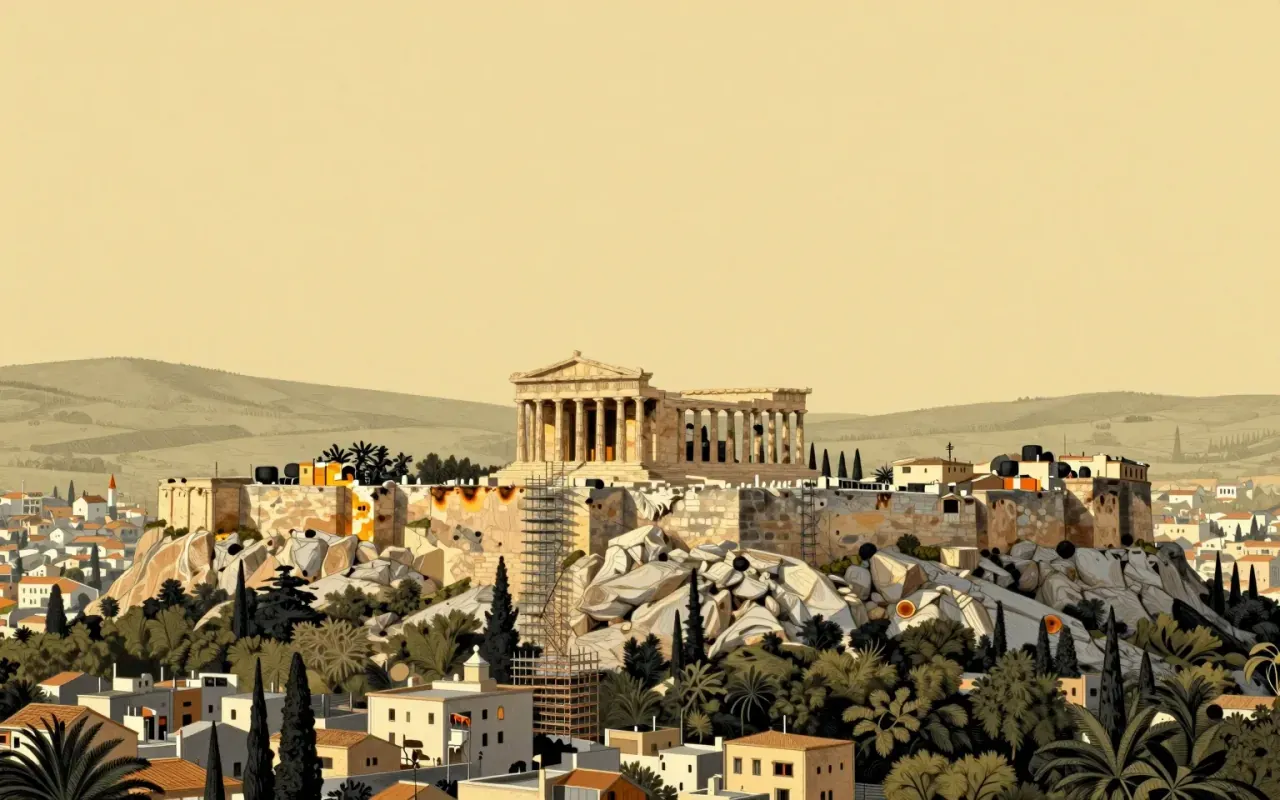
Persia kept its empire and made no further attempt to conquer mainland Greece, but it also stopped expanding westward, and Macedonia and the Ionian cities regained a measure of independence they had lost decades before. Athens, whose fleet had done the most to win at Salamis, emerged as the leading naval power among the Greek states and used that standing to found the Delian League, ostensibly a defensive alliance against further Persian attack. Within a generation that league had turned into an Athenian empire in its own right, funding the building programme on the Acropolis and setting up the rivalry with Sparta that would end in the Peloponnesian War. The idea of Greek freedom defended against an eastern despot also became a fixture of how Greeks described themselves, well beyond its usefulness as a description of the actual campaigns.
A founding story, oddly reliable
The Persian Wars matter less as a settled sequence of facts than as an early case study in how history gets written and then trusted. Herodotus invented much of the method still used to judge his own claims, checking testimony against testimony, and the wars are a good place to watch that method work and occasionally strain under the weight of round numbers and good stories. Readers drawn to military narrative will find real battles with real stakes; readers more interested in historiography will find, in the gap between Herodotus’s totals and modern estimates, a clear demonstration of why ancient numbers need handling with care. Either way, the episode rewards attention because so much of what people assume about it, including the odds the Greeks supposedly overcame, rests on a single source that was already retelling old news.