A medicine becomes a habit
Opium reached China through Arab traders as early as the seventh century, used initially as a medicine, and appears as a listed taxable commodity in Ming dynasty records from 1589. Recreational smoking spread gradually over the following two centuries, prompting the Yongzheng Emperor’s first prohibition edict in 1729, at a point when annual imports stood at roughly 200 chests. By 1799 the Jiaqing Emperor reissued the ban in stronger terms as imports had already climbed to around 4,500 chests, a scale that made clear the earlier prohibition had done little to slow the trade’s growth, and by the 1830s expansion accelerated further still, with imports reaching some 40,000 chests annually just before war broke out in 1839.
Edicts that couldn’t keep pace
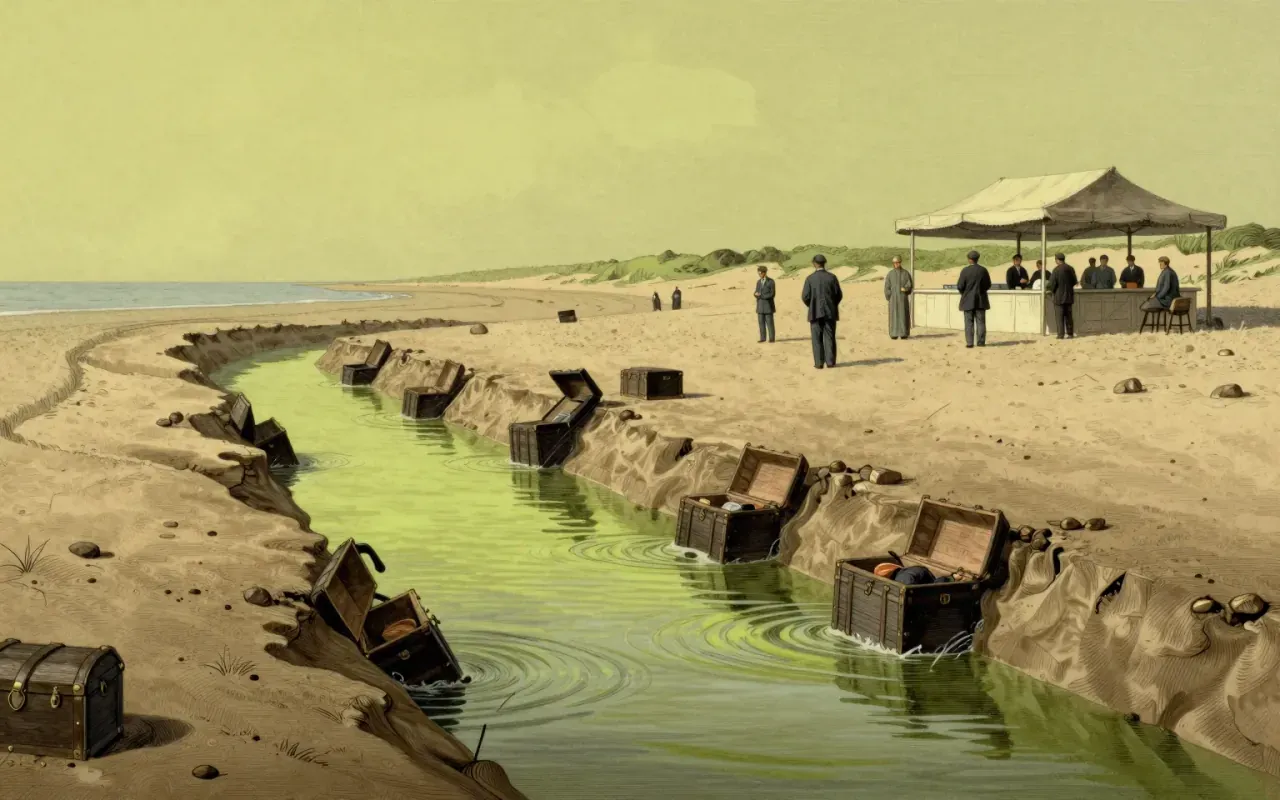
The scale of nineteenth-century opium imports is documented through British East India Company and trading records alongside Qing administrative sources, giving historians reasonably reliable figures for the volume of the trade even where addiction rates among the Chinese population remain harder to pin down precisely. Commissioner Lin Zexu’s 1839 confiscation and destruction of foreign opium stocks in Canton, roughly a thousand long tons destroyed over twenty-three days, is well documented from both Chinese and British sources and directly triggered the First Opium War. The subsequent treaties that formally legalised the trade, agreed at Tianjin in 1858 and confirmed by the Convention of Peking in 1860, exist as full legal texts specifying opium’s legalisation as an explicit negotiated term rather than an incidental provision.
Twenty-three days, a thousand tons burned
China’s prohibition efforts consistently lagged behind the trade’s growth for structural reasons beyond simple enforcement failure. Rising demand within China combined with British commercial interest in balancing a trade deficit that silver exports to pay for Chinese tea and silk had created, giving British merchants and eventually the British government a direct financial stake in expanding rather than curbing the trade. When the Second Opium War concluded, legalising opium imports was one of Britain’s explicit war aims alongside opening additional ports and securing a permanent embassy in Beijing, and by 1858 annual imports had reached roughly 70,000 chests, a volume historians note was comparable to a full year’s global opium production a century and a half later.
Legalised by treaty, not by choice
A genuine and largely successful suppression campaign followed from 1901, when the Qing government, chastened by the Boxer Rebellion’s aftermath, renewed efforts against both imported and domestically grown opium, securing a 1907 agreement with Britain to phase out Indian exports over a decade. By 1909, consumption had reportedly fallen by roughly a third in Manchuria and nearly disappeared in Beijing and Shanxi province, a genuine policy achievement that historian Jonathan Spence and others treat as evidence the trade could be curtailed once the state committed sustained resources to the effort. That progress reversed almost immediately after the Qing dynasty’s 1911 collapse, as fragmented provincial governments resumed taxing opium cultivation and trade for revenue, and the Nationalist government under Chiang Kai-shek maintained a similarly contradictory stance through the 1920s and 1930s, officially opposed to opium while running suppression bureaus that functioned as disguised monopolies.
A decade of real progress, reversed
By 1949, when the Communist Party took power, an estimated twenty million or more people, some 4.4 percent of the population, were addicted, prompting the new government to launch prohibition directives in 1950 and a comprehensive eradication campaign in 1952. This campaign relied on methods far more coercive than any prior effort, including forced labour rehabilitation, public burnings of confiscated opium, and executions of distributors, and succeeded in essentially eliminating widespread urban consumption within Chinese cities by 1953, though cultivation persisted longer in some rural and ethnic minority regions, continuing into the late 1950s in certain areas before being fully suppressed.
Eradication through force
The story is worth following past the two wars that usually define it, because the century either side of them shows a more complicated pattern: repeated Chinese attempts at prohibition undercut first by foreign military pressure and treaty obligation, then by domestic political fragmentation, and finally overcome only by a state willing to apply extreme coercion to its own population. Reading the full arc, from Lin Zexu’s defiant 1839 burning through the treaty-mandated legalisation to the eventual 1950s eradication, makes clear that the trade’s persistence for so long was never simply a matter of Chinese policy failure, but of successive governments lacking either the external leverage or the internal authority to make prohibition stick.