A slave army seizes the throne
The Mamluk Sultanate emerged from a violent transfer of power within the ruling structure of Ayyubid Egypt. Mamluks were manumitted slave soldiers, typically purchased as boys and trained for military service, distinct from household slaves and often achieving considerable status and wealth despite their origin. On 2 May 1250, a group of disaffected Salihi emirs assassinated the Ayyubid ruler al-Muazzam Turanshah, and out of the resulting upheaval emerged a new form of government led first by Shajar al-Durr and then by Aybak, both drawn from the same military caste that had just overthrown its former masters. This was not a single dynasty replacing another so much as an entire method of recruiting and organising military power becoming the source of political legitimacy itself.
Stopping the Mongols at Ain Jalut
The new sultanate’s most consequential early military achievement came against the Mongol Empire, whose westward expansion had already destroyed Baghdad and threatened to sweep through Egypt as it had through much of the rest of the Islamic world. At the Battle of Ain Jalut in September 1260, Sultan Qutuz and his commander Baybars defeated Mongol forces under the general Kitbuqa, a victory that halted the Mongol advance and marked one of the first significant defeats the Mongols had suffered in their westward campaigns. The battle established Mamluk military credibility from the sultanate’s earliest years and positioned Baybars, who would soon become sultan himself, as the dominant military figure of the new state.
Clearing the last Crusader footholds
Mamluk forces spent the following decades systematically eliminating the remaining Crusader presence in the Levant, conquering coastal fortresses and inland cities across Syria and Palestine between roughly 1265 and 1293. The campaign reached its conclusion in 1291, when Sultan al-Ashraf Khalil captured Acre, the last major Crusader stronghold in the region, ending the long era of organised Crusader territorial control on the Levantine coast. This achievement, combined with the earlier victory over the Mongols, gave the Mamluk Sultanate a claim to having defended the Islamic world against both of its most serious external threats within a single generation of the state’s founding, a record that underpinned its authority for the century that followed.
Government by promotion, not bloodline
Mamluk governance operated on principles distinct from hereditary monarchy elsewhere in the region. The sultanate functioned as what is described as a semi-feudal, elective military monarchy, with power resting on an oligarchy of emirs rather than a fixed royal bloodline, meaning succession depended heavily on military standing and political alliance rather than simple inheritance. Revenue and loyalty were organised through the iqta system, under which mamluks received grants of land and its associated income in exchange for continued military service to the sultan. A puppet Abbasid caliph, maintained in Cairo after the Mongol destruction of Baghdad, provided a layer of religious legitimacy for a political order that was, in practical terms, run entirely by its military elite.
The Black Death arrives
The sultanate’s stability was severely tested by the arrival of the Black Death in Egypt in 1347 and 1348, part of the same pandemic that devastated populations across Europe, the Middle East, and Asia in this period. The resulting mass mortality caused major social and economic disruption within Mamluk territory, destabilising succession arrangements that already depended on a continuous supply of trained military manpower, weakening agricultural production that funded the state through the iqta system, and reducing the pool of new mamluks available for recruitment and training. These demographic and economic pressures did not end the sultanate outright but left it structurally weaker for the remainder of its existence than it had been during its thirteenth-century peak.
Outgunned by the Ottomans
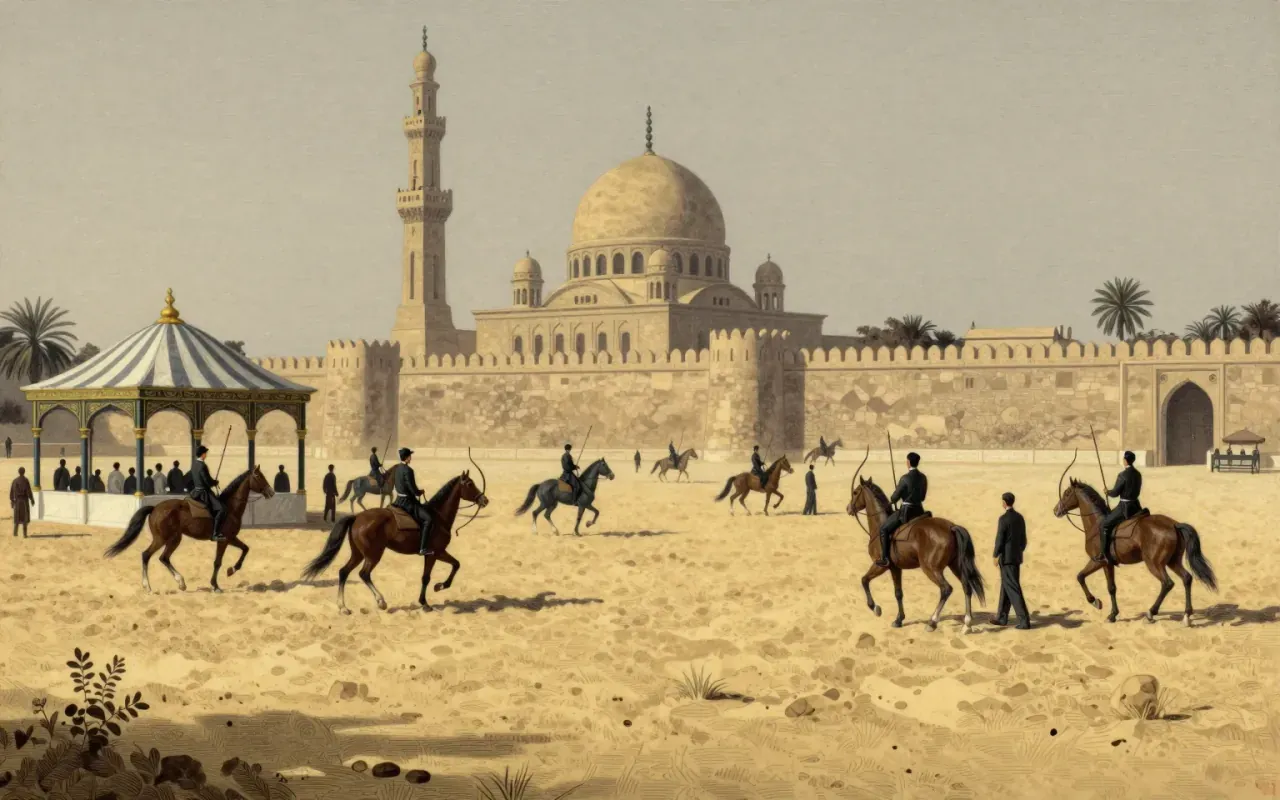
The sultanate’s final crisis came from a rival power that had adapted to gunpowder warfare more thoroughly than the Mamluks themselves had. Ottoman forces under Selim I defeated Mamluk armies decisively at the battles of Marj Dabiq in 1516 and Ridaniya in January 1517, victories attributed substantially to Ottoman use of firearms and artillery against Mamluk forces still reliant on traditional cavalry and archery, and whose horses reportedly panicked under sustained cannon fire. Selim captured Cairo in the days following Ridaniya, ending 267 years of Mamluk sovereignty on 22 January 1517 and absorbing Egypt, Syria, and eventually the Hejaz into Ottoman territory, along with the caliphate itself, which passed from Cairo to Constantinople as part of the conquest’s aftermath.