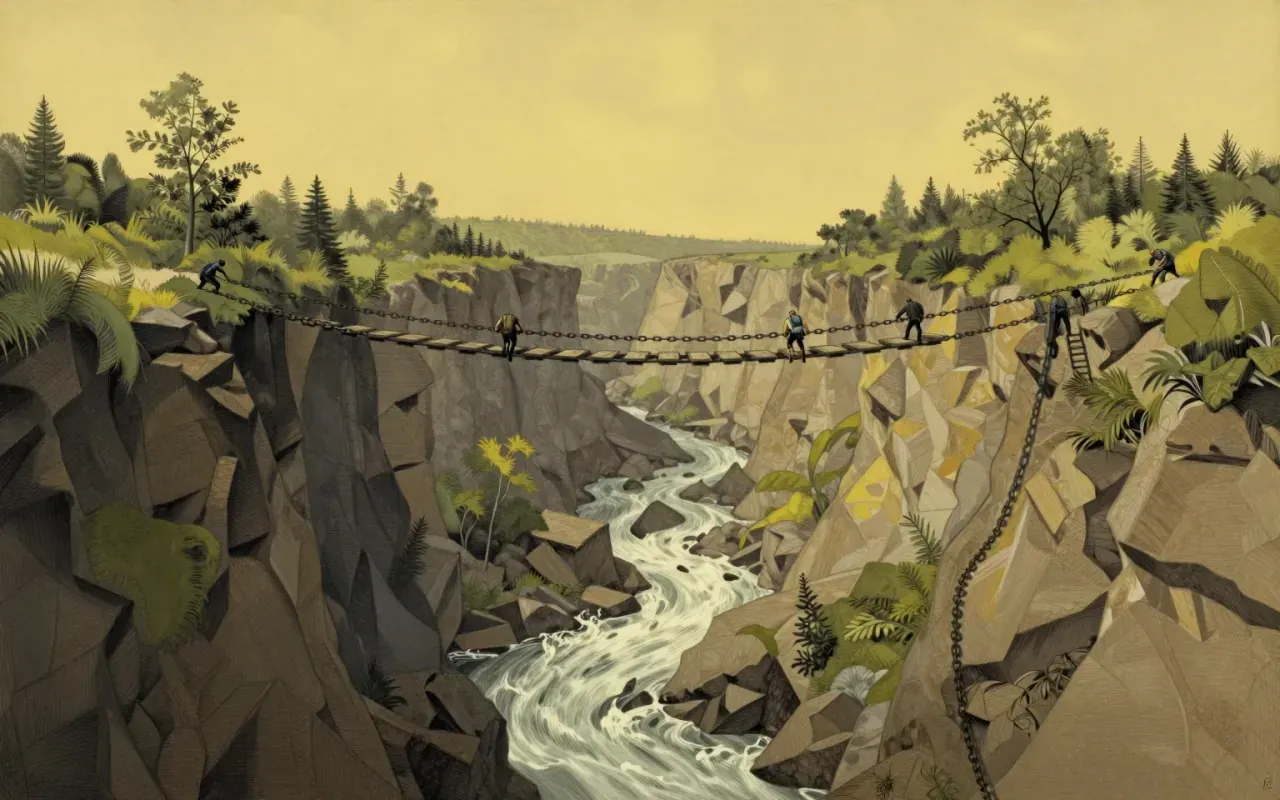
Breakout from Jiangxi
Encircled by Nationalist forces in their Jiangxi base, roughly 86,000 Communist soldiers and officials broke out near Yudu in October 1934, beginning a retreat that would not end for a year. Crossing the Xiang River that December cost the column tens of thousands of people, leaving perhaps 36,000. At Zunyi in January 1935 party leaders met to reassign blame for the losses, a meeting that began Mao Zedong’s rise within the leadership though he did not yet hold formal command. The marchers crossed the upper Yangtze, fought at the Luding Bridge, and struggled through the Zoige grasslands before reaching Shaanxi in October 1935; a separate force joined them the following year. Of roughly 100,000 who set out, official figures put the survivors at fewer than 7,000, though how many died in fighting rather than from hunger, cold or desertion was never clearly recorded.
The Xiang River disaster
The best-known early account is the American journalist Edgar Snow’s book on Red China, published in 1938, not long after the march ended and based on interviews Snow conducted with Mao and other survivors in Yan’an. It fixed the figure of twenty-five thousand li, about twelve thousand kilometres, as the march’s length, a number that became the fixed official distance even though Mao’s own poem written at the march’s end gives a shorter figure. Later Chinese state media and film treated the retreat as heroic proof of the party’s resilience, an interpretation formed well after the events it describes and shaped by the needs of the government that eventually resulted from them. A 2006 British expedition that retraced parts of the route produced a much shorter distance estimate, prompting Chinese outlets to argue the researchers had followed the wrong path rather than accept a revision to the founding story.
Zunyi and Mao’s rise
The retreat itself was forced by military failure: Nationalist blockhouse tactics had steadily strangled the Jiangxi base, and by late 1934 the Communist leadership judged that staying meant annihilation. Early decisions were made by a small group including the German Comintern adviser Otto Braun, whose conventional tactics are blamed by later accounts for the catastrophic losses at the Xiang River. The Zunyi conference shifted authority toward Mao and away from that earlier leadership, though he did not gain full military command until months afterward and did not become party chairman until 1943. Discipline toward the rural population along the route, formalised in rules about paying for supplies and respecting local customs, helped the marchers pass through hostile territory and win some sympathy from peasants who had never encountered the party before. Survival, more than any single battle, depended on this combination of desperate necessity and calculated restraint.
Arrival in Shaanxi
The distance travelled remains genuinely unsettled: the long-standing figure of twenty-five thousand li conflicts with Mao’s own contemporaneous poem, and a modern British retracing arrived at a total less than half the traditional one, an argument that has not been resolved and that carries obvious political weight for the version China’s government prefers. The celebrated crossing of the Luding Bridge, long presented as a daring assault under fire, is now considered by some historians to have been exaggerated or invented for propaganda purposes, though others defend the traditional account. Casualty figures are similarly soft, since surviving records cannot separate deaths in combat from deaths by illness, starvation or desertion, and no reliable breakdown exists. Some writers have also argued Mao deliberately slowed the march to consolidate his own power, a claim other historians consider unsupported by solid evidence rather than established fact.
A contested legend
Whatever its precise length and cost, the march delivered the Communist Party into a defensible northern base around Yan’an, where it spent the following decade rebuilding while nominally allied with the Nationalists against Japanese invasion. Mao emerged from the episode as the party’s dominant figure, a position he and his close ally Zhou Enlai held without serious internal challenge for the rest of their lives. Many who survived the retreat, including Zhu De, Deng Xiaoping and Liu Shaoqi, went on to lead the People’s Republic after 1949, giving the march’s veterans decades of influence over how the country was run. The peasant goodwill won along the route also became a template for later Communist mobilisation, and the episode’s later celebration as a founding myth gave the party a story of resilience it would repeat for generations after taking power.
What it built
It is worth the time precisely because so much of the familiar version turns out to be softer than it appears once the numbers are pressed: the distance, the casualties and even the most cinematic battle are all disputed to some degree, yet the underlying facts of a shattered force stumbling a very long way through hostile country to political survival are not in question. Readers who want a founding legend told at face value should look elsewhere, but those willing to sit with genuine uncertainty about scale and heroism will find a story that says as much about how nations manufacture usable pasts as about the events of 1934 and 1935 themselves. The gap between what happened and what it was later made to mean is unusually wide here, and unusually well documented on both sides of that gap.