Infantry against cavalry
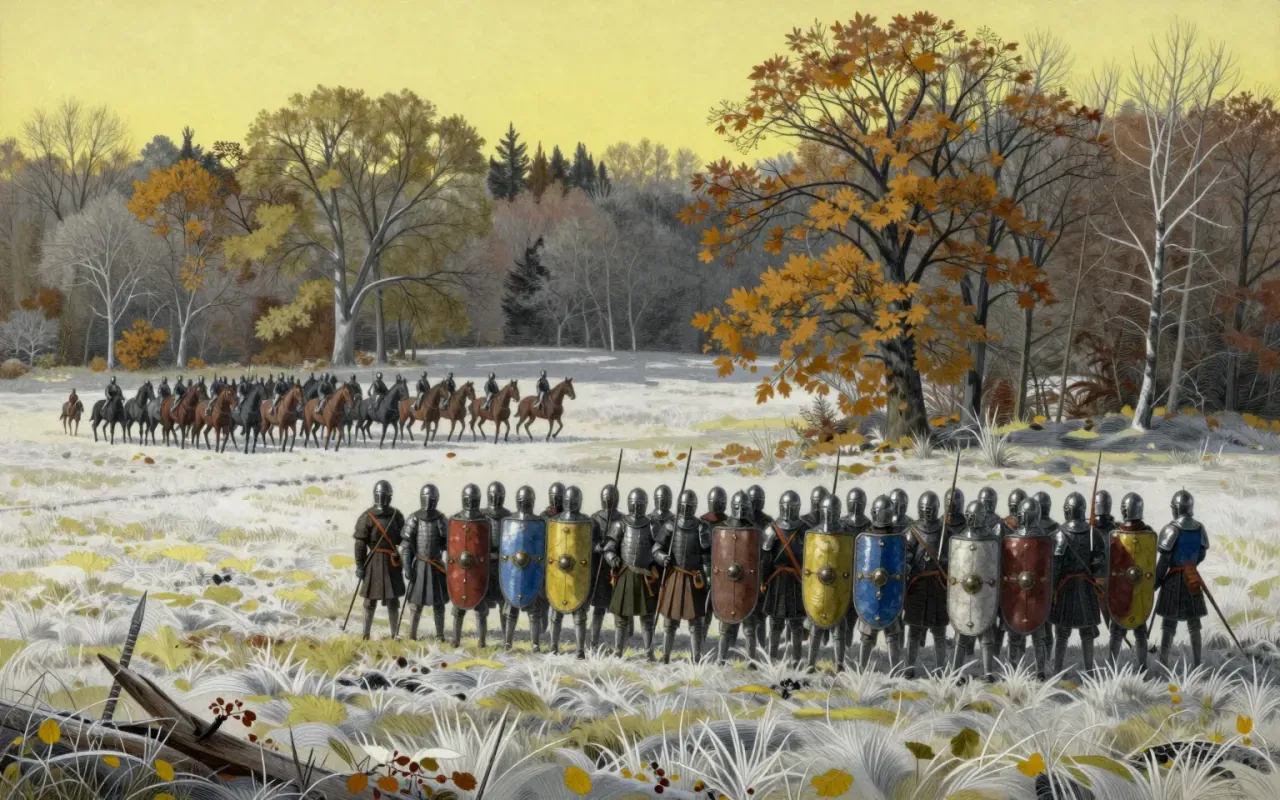
On 10 October 732, near the town of Tours in what is now central France, a Frankish force under Charles Martel met an Umayyad army that had already crossed the Pyrenees, defeated the regional duke Odo at Bordeaux, and pushed north under the governor Abd al-Rahman al-Ghafiqi. The two armies faced each other for several days before fighting broke out; Frankish infantry held their formation against repeated cavalry charges, and Abd al-Rahman was killed during the engagement. That night the Umayyad camp withdrew southward without further battle, ending the advance. Modern estimates put each side at somewhere between fifteen and thirty thousand men, far below the wildly inflated figures, running into the hundreds of thousands, that later medieval chroniclers reported. A second Umayyad expedition several years later was likewise turned back, and Umayyad forces were confined to the Mediterranean coast of Gaul until Charles’s son captured their last stronghold there in 759.
A recycled casualty count
The fullest contemporary account comes from a Latin chronicle completed in 754, which describes the Umayyad army as more numerous than the Franks but offers little further detail. A separate chronicle tradition maintained by Charles’s own family understandably casts the battle in flattering terms, while a brief Lombard history written decades later shows contemporaries already confusing casualty figures between this battle and an earlier Frankish victory at Toulouse. That confusion matters because the frequently repeated claim of some three hundred and seventy-five thousand Umayyad dead appears to have been lifted from records of the Toulouse battle and mistakenly attached to Tours by later writers rather than reported independently at the time. Arab and Muslim sources, by contrast, barely mention the engagement at all, and where later Arabic historians do refer to it, centuries afterward, they generally describe it as a minor reverse rather than a significant defeat, a striking contrast with its outsized reputation in Western retelling.
A raid, not a conquest
Charles’s victory depended on disciplined infantry holding a defensive position against repeated cavalry assaults rather than any dramatic tactical innovation, a formation that denied Umayyad horsemen the room to break through Frankish lines over the course of the fighting. The death of Abd al-Rahman during the battle removed the campaign’s commanding officer at a critical moment, and without him the army chose to withdraw overnight rather than press on or regroup, suggesting the expedition’s cohesion depended heavily on his personal leadership. The likeliest motive for the Umayyad advance in the first place was plunder, particularly the wealth of a prominent monastery near Tours, rather than any settled plan of permanent territorial conquest that far north, meaning the encounter may have functioned more as a large raiding expedition meeting unexpectedly firm resistance than as a decisive clash between civilisations each committed to holding the ground being fought over.
Did it save Europe
No aspect of Tours generates more disagreement than whether it deserves its reputation as a battle that saved European Christendom. Eighteenth and nineteenth-century historians including Edward Gibbon and Leopold von Ranke treated it as one of history’s genuine turning points, with Gibbon famously speculating that continued Muslim advance might otherwise have reached deep into northern Europe. Twentieth and twenty-first-century historians have pushed back hard against that framing: Alessandro Barbero argues the battle’s significance has been dramatically overstated given that the Umayyad force was most plausibly a raiding expedition rather than an army of conquest, while Bernard Lewis notes contemporary Arab sources treated it, when they mentioned it at all, as a minor skirmish rather than a civilisational defeat. A middle position, associated with the historian Paul Davis, holds that whatever its cosmic significance, the battle unambiguously secured Frankish dominance over Gaul for the following century, a more modest but still substantial claim than the grander civilisation-saving narrative asserts.
A dynasty’s foundation
Whatever its wider civilisational significance, the immediate beneficiary of the battle was Charles himself, who emerged with enhanced authority while Odo, the regional duke who had first appealed for Frankish help, saw his own independent standing weakened and his territory eventually absorbed after his death a few years later. Repelling a second Umayyad expedition later in the decade confined Muslim forces permanently to a small coastal strip of Gaul, which Charles’s son finally cleared of Umayyad garrisons decades afterward. The consolidated authority Charles built from this and his other campaigns passed to his son, who became the first Carolingian king, and then to his grandson Charlemagne, whose later empire reshaped medieval Europe. In this sense the battle’s clearest legacy lies not in halting some hypothetical conquest of the continent but in the specific dynastic and territorial foundation it helped lay for the Carolingian order that followed.
Myth outgrowing its record
Tours is worth studying mainly as a case study in how a battle’s reputation can grow far larger than its documented facts support, since the gap between the modest, poorly recorded engagement described in near-contemporary sources and the civilisation-defining myth built up over the following thousand years is genuinely instructive on its own terms. Readers should approach the frequently cited casualty figures and the grandest claims about Europe’s fate with real scepticism, since both rest on later invention or recycled numbers rather than anything reported at the time. What remains solid is more modest but still significant: a disciplined infantry force held its ground against cavalry, a capable enemy commander died at a crucial moment, and the resulting shift in regional power helped set the stage for the Carolingian dynasty. Readers drawn to the drama of civilisational stakes should be aware they are engaging with myth-making at least as much as with history.