A split army overwhelmed
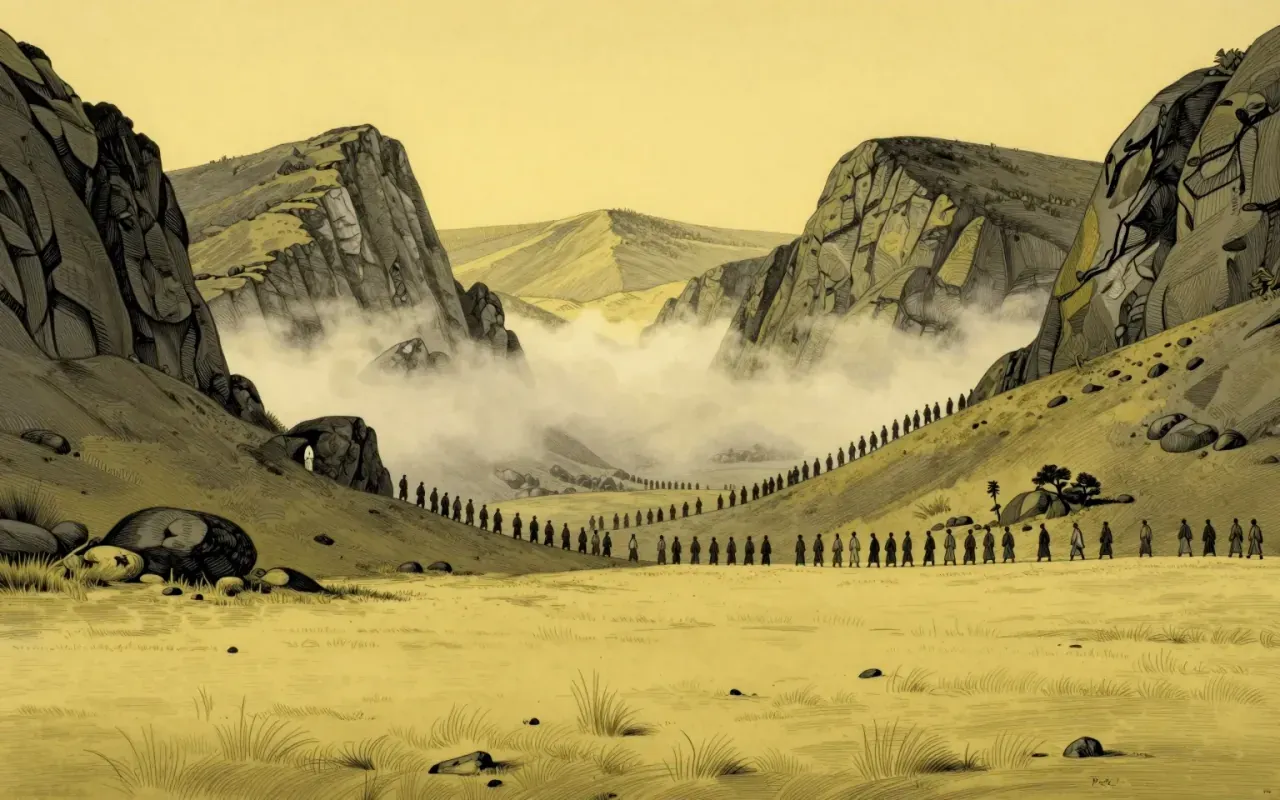
On 1 March 1896, an Italian force under General Oreste Baratieri, numbering roughly thirty thousand including colonial troops, attacked Ethiopian positions near the town of Adwa despite low provisions and uncertain intelligence about the terrain ahead. Confusion over routes split the advancing Italian columns, and Emperor Menelik’s much larger army, reinforced by reserves under Empress Taytu that arrived mid-morning, overwhelmed the separated brigades in turn over the course of the day. By early afternoon a general Italian retreat was underway, continuing through the following night as survivors fled south. Italian losses, variously reported at around six thousand killed with additional wounded and prisoners taken, represented one of the heaviest defeats a European colonial power suffered in Africa during this period. The battle grew directly out of a dispute over the Treaty of Wuchale, whose conflicting Italian and Amharic versions had left Italy claiming a protectorate over Ethiopian foreign policy that Menelik had never actually accepted.
Rich sources, disputed numbers
The battle is documented from both sides in unusual depth for a nineteenth-century African conflict, including official Italian military telegrams sent to Rome in the immediate aftermath, contemporary reporting by the Italian journalist Adolfo Rossi, and later interviews gathered from battlefield visitors and surviving participants within months of the fighting. Modern historians including Harold Marcus, Richard Pankhurst and Raymond Jonas have worked from this combination of Italian official records, Ethiopian oral and written testimony, and diplomatic correspondence surrounding the earlier treaty dispute to reconstruct the engagement in considerable tactical detail. Even so, basic figures remain contested between serious historians working from the same broad body of evidence, with Italian combat troop numbers estimated anywhere between roughly fourteen and eighteen thousand and Ethiopian casualty figures varying even more widely, a reminder that documentary richness does not by itself guarantee agreement on the underlying numbers.
Preparation against overreach
Italy’s defeat followed directly from a mismatch between ambition and preparation: General Baratieri advanced despite serious supply shortages and pressure from Rome to produce a quick victory, while his subordinate commanders lost cohesion navigating unfamiliar terrain with unreliable local guides, splitting the army into isolated fragments the far larger Ethiopian force could defeat piecemeal rather than all at once. Menelik, by contrast, had spent years building an army equipped with modern rifles and substantial artillery, purchased in part through the same diplomatic engagement with European powers that had produced the disputed treaty in the first place, meaning Ethiopia entered the fight considerably better armed than Italian planners had assumed. Empress Taytu’s timely arrival with reserves during the battle’s early hours reinforced the numerical advantage at precisely the moment Italian columns were already fragmenting, converting an Italian tactical miscalculation into the decisive rout that followed by early afternoon.
Wisdom or hesitation
Historians disagree over several specific points despite the relatively rich documentary record. The cause of the fatal split among Italian columns is variously attributed to faulty maps, poor guides, or straightforward command confusion, with different historians assigning different weight to Baratieri’s own culpability against these more circumstantial failures. Whether Menelik’s decision not to pursue the retreating Italian army into neighbouring Eritrea reflected shrewd strategic restraint or a loss of nerve at a moment of apparent advantage remains genuinely debated, with the historian David Levering Lewis crediting farsighted calculation and others suggesting hesitation, while a contemporary Italian officer speculated Ethiopian forces might have collapsed within weeks had fighting continued. Casualty figures for both sides vary meaningfully between respected historians working from similar sources, and questions also remain about the full extent of mistreatment of captured colonial soldiers, since documented amputations sit alongside disputed and less certain claims of further abuse.
A government falls
News of the defeat brought down the Italian government within days, as Prime Minister Francesco Crispi resigned amid public demonstrations, closed theatres and universities, and widespread national shock at a loss inflicted by an African army. Italy formally abandoned its protectorate claims and recognised full Ethiopian sovereignty under the resulting Treaty of Addis Ababa, securing Ethiopian independence for roughly four decades until a later Italian invasion in the 1930s. Across the wider continent, Adwa became a reference point for African resistance to colonial rule and later fed directly into Pan-African political thought during the twentieth century’s anti-colonial movements, standing as the clearest example during the Scramble for Africa of an African state defeating a European power outright rather than being absorbed by it. In Italy, the defeat became a lasting source of national humiliation that fascist propaganda would later invoke explicitly when Mussolini’s forces finally occupied Ethiopia in 1936.
A reference point for resistance
Adwa deserves attention as one of the clearest counterexamples to the broader story of nineteenth-century European colonial expansion, and it rewards study precisely because the record is detailed enough to show exactly how the Italian defeat happened rather than leaving it as an abstract symbol of resistance. Readers interested in colonial military history, in the mechanics of how supply failures and command confusion can undo a technologically advantaged army, or in the roots of twentieth-century African political thought will find the battle unusually well suited to close examination. Its significance does not rest on any single disputed detail, whether exact casualty counts or the precise reasoning behind Menelik’s decision not to pursue his retreating enemy, since the outcome itself, an African army decisively defeating a European colonial force and preserving national sovereignty as a direct result, remains beyond serious dispute regardless of how those individual questions are eventually resolved.