A city built without streets
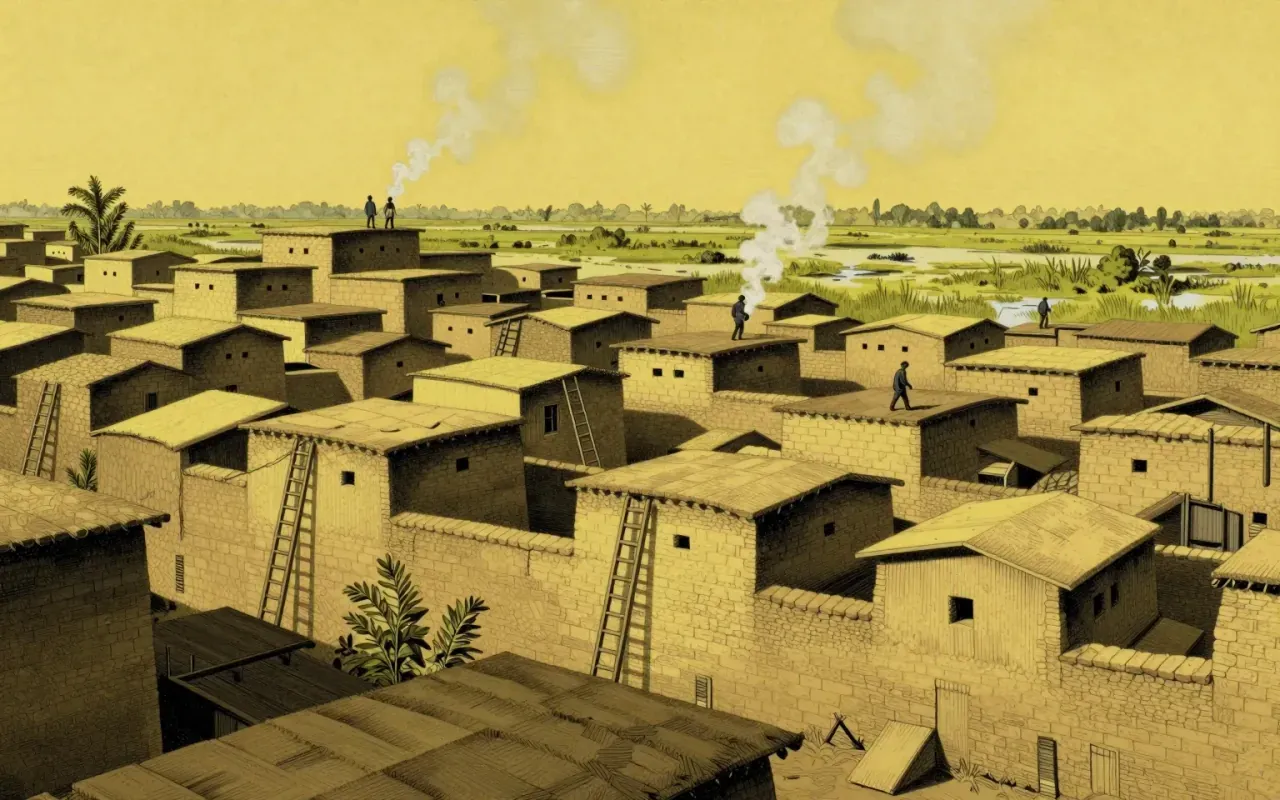
Catalhoyuk was occupied from approximately 7500 to 5600 BC in southern Anatolia, with its main period of development around 7000 BC on what archaeologists call the Eastern Mound, while a smaller Western Mound shows later Early Chalcolithic occupation beginning around 5600 BC. The settlement is distinguished by its unusual density: houses were built in tightly packed, honeycomb-like clusters with no streets between them, and residents entered their homes through openings in the roof rather than ground-level doors. Excavation has revealed eighteen successive layers of building on the same site, reflecting repeated rebuilding directly atop earlier structures over an extended period of continuous occupation.
Eighteen layers of the same settlement
The site was discovered in 1958 by James Mellaart during a regional survey, and his excavations between 1961 and 1965 uncovered extensive domestic architecture along with artefacts including textiles, obsidian tools and more than 2,500 clay figurines. A second major excavation phase, led by Ian Hodder from 1993 to 2018, applied considerably more modern methodology, including digital recording, systematic sampling strategies and direct community involvement, and in the process recovered roughly 2,000 additional figurines that gave researchers a much larger dataset than Mellaart had worked with to test his original interpretations against.
A goddess theory built on one excavator’s figurines
Mellaart’s excavations led him to argue that the settlement’s figurines reflected a dominant female deity at the centre of its religious life, alongside a broadly egalitarian social structure across the community, interpretations that shaped how Catalhoyuk was understood by both scholars and the public for decades afterward. This picture rested substantially on how Mellaart chose to read a comparatively small sample of figurines recovered during his own more limited excavation, an interpretation that later, more extensive fieldwork would have the opportunity to test against a considerably larger body of physical evidence.
A later dig complicates the theory
Hodder’s team, working with a much larger figurine sample, found very little evidence supporting Mellaart’s mother-goddess interpretation, noting that most recovered figurines actually depict animals rather than human or specifically female forms, undermining the basis for the earlier religious reading. A separate 2014 study complicated the egalitarian social structure Mellaart had proposed, finding evidence that wealth distribution, visible through unevenly distributed storage units and grinding stones, became increasingly unequal over the settlement’s history rather than remaining consistently flat. Most recently, a 2025 genetic study identified matrilineal kinship patterns at the site, though scholars remain divided over whether this finding constitutes evidence of matriarchy in any broader social or political sense.
Mostly animals, not mostly goddesses
Catalhoyuk’s significance rests on its status as one of the earliest large permanent human settlements, demonstrating sophisticated community organisation and mudbrick construction techniques at a scale unusual for its period, well before comparable urban developments elsewhere in the ancient world. UNESCO designated the site a World Heritage location in 2012, and a dedicated museum opened in 2023 featuring eight rooms including an underground reconstruction of a typical dwelling, giving visitors direct physical access to the settlement’s distinctive architectural style rather than only the excavated ruins themselves, a presentation choice that makes the site’s unusual roof-entry design far easier for non-specialists to grasp.
Genetics reopens the kinship question
This is a genuinely instructive case study in how a single excavator’s interpretation, however influential, can dominate popular understanding of a site for decades until a later, more extensive excavation tests it against a larger body of evidence and finds it wanting. It rewards attention for that specific arc from Mellaart’s goddess theory to Hodder’s more cautious findings. It is less satisfying if you want a confident final verdict on the settlement’s social structure, since the evidence for growing inequality and the genetic kinship findings both raise as many questions as they answer.