One treaty, four powers, a redrawn map of three continents
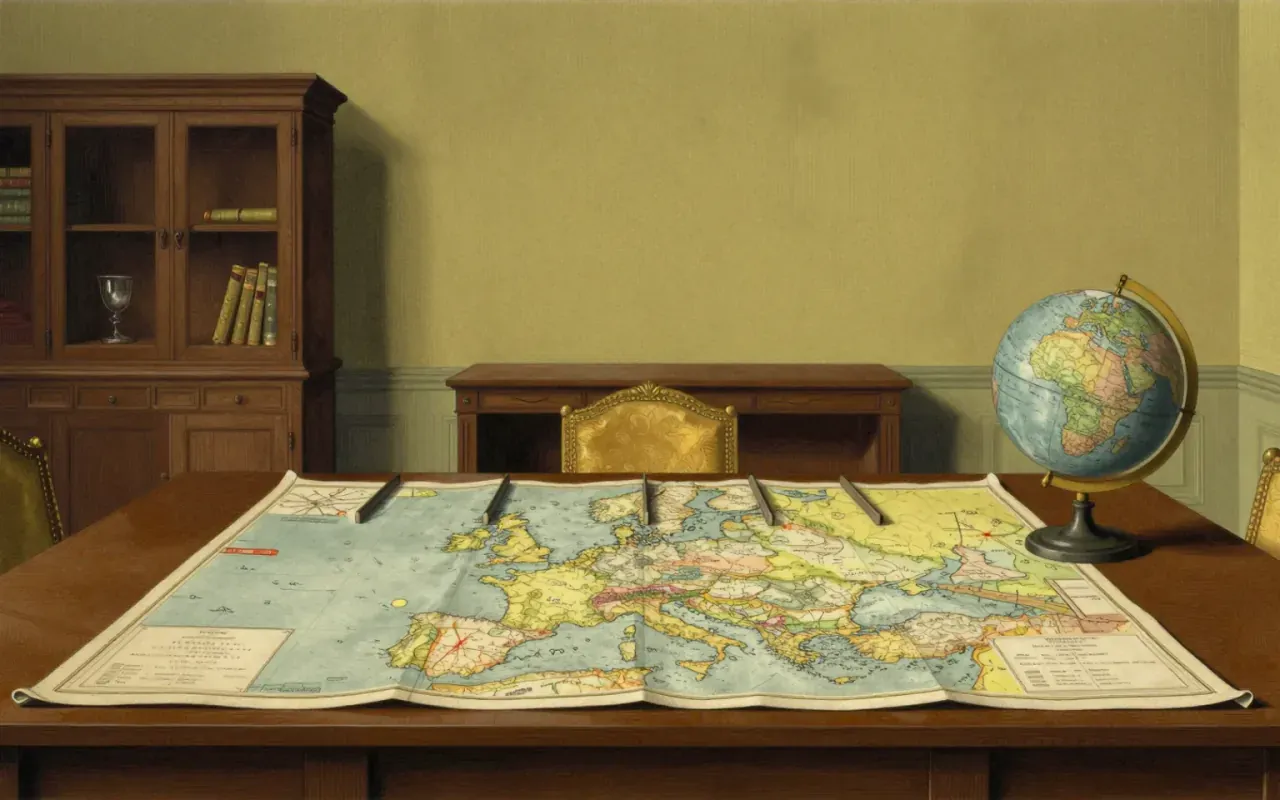
Signed on 10 February 1763 in Paris, the treaty was negotiated by John Russell, Duke of Bedford, for Britain, Cesar Gabriel de Choiseul, Duke of Praslin, for France, and Jeronimo Grimaldi for Spain, with Portugal joining the settlement. France ceded Canada, Nova Scotia and Cape Breton to Britain, along with its territory east of the Mississippi River, while its remaining Louisiana territory west of the river passed to Spain, which had already received it secretly the previous year. Spain ceded Florida to Britain in exchange for the return of Havana and Manila, both captured by British forces during the war, and Britain returned Guadeloupe, Martinique and Saint Lucia to France while keeping Grenada, Dominica, Saint Vincent and Tobago.
A settlement written down and argued over in Parliament the same year
The treaty’s text survives in full, preserved at Yale’s Avalon Project among other archives, so its specific clauses, including guarantees of Catholic religious practice in ceded Canada and free navigation of the Mississippi for both British and French subjects, are not in dispute. Its reception is likewise well documented through the British parliamentary record, since the government of Lord Bute submitted the settlement for approval and it passed by a vote of 319 to 65 despite vocal opposition. That combination of a preserved treaty text and a recorded contemporary debate gives historians an unusually clear window onto both what was agreed and how it was received at the time.
A war that had already cost hundreds of thousands of lives
The Seven Years’ War had by 1763 produced enormous losses among its combatants: estimates cited for the conflict put French deaths at around 200,000, Prussian deaths near 180,000, British deaths near 160,000, and further large tolls for the Holy Roman Empire, Russia, Spain and Sweden, a combined toll well over half a million soldiers. Both sides had also exhausted enormous sums financing the fighting across Europe, North America and India. That scale of cost, on top of years of fighting with no single power capable of a decisive final victory, pushed all the belligerents toward a negotiated peace rather than a continuation of the war.
Canada over Guadeloupe: strategy or a bad trade
A lasting debate concerns Britain’s choice to retain Canada rather than the Caribbean island of Guadeloupe, which at the time generated far greater sugar revenue, reportedly around six million pounds a year, than the fur trade and fisheries of Canada. William Pitt the Elder argued in Parliament that the settlement was insecure and inadequate, warning that France would use the peace to rebuild and threaten Britain again. Voltaire, on the French side, dismissed the loss of the snowbound colony as a trade of little consequence. Historians remain divided on whether Britain’s decision reflected shrewd long-term strategic judgement or an undervaluing of the Caribbean sugar economy’s immediate worth.
A new map that unsettled the colonies it was meant to secure
The treaty’s provisions had consequences beyond the territories they redrew. Article Four gave French Canadians eighteen months to leave the newly British colony, though only around 1,600 did so, and its guarantee of Catholic worship, combined with the same year’s Royal Proclamation restricting colonial settlement west of the Appalachian Mountains, angered Protestant colonists in the older thirteen colonies who had expected to expand westward after the war’s end. Those grievances, layered onto disputes over how the war’s costs should be repaid through colonial taxation, fed directly into the unrest that grew into the American Revolution roughly a decade later.
Worth reading for the argument it settled and the one it started
The treaty rewards a closer look mainly because its terms were contested from the moment they were signed, both across the English Channel and within Britain’s own Parliament, and because the settlement’s fine print, on religion, on navigation rights, on where colonists could settle, did as much to shape the following decades as its headline territorial transfers did. Readers already familiar with the broad outcome, French power reduced in North America, gain the most from tracing how a peace meant to secure British dominance also planted specific, documented grievances among the colonists it was supposed to benefit.