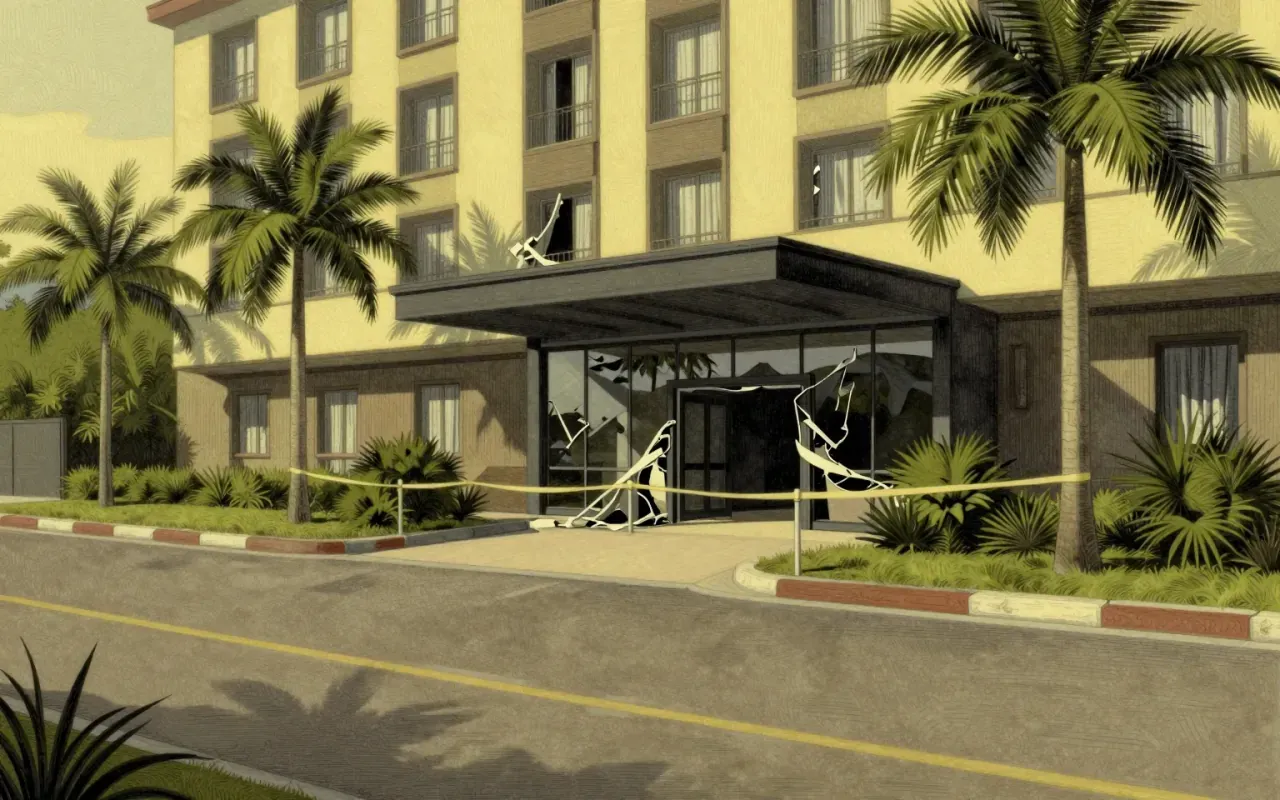
A car bomb in a hotel lobby, twelve dead plus the bomber
On 5 August 2003, at 12:45 p.m., a Toyota Kijang loaded with explosives was driven through the taxi stand and into the lobby of the JW Marriott hotel in Jakarta before detonating, killing twelve people, eleven Indonesians and one Dutch national, along with the bomber, and injuring around 150 more. Security footage showed a guard briefly approaching the vehicle shortly before the explosion. The hotel closed and did not reopen until 8 September, roughly five weeks later, and the attack had immediate financial repercussions, with the Jakarta Stock Exchange falling 3.1 percent and the rupiah losing about 2 percent of its value against the dollar in the aftermath.
Forensic chemistry linked one bomber to two earlier attacks
Forensic investigators identified the bomber as Asmar Latin Sani, a twenty-eight-year-old from West Sumatra, whose remains were found on the building’s fifth floor and confirmed through identification by two already-jailed Jemaah Islamiyah members who had recruited him. The bomb’s chemical composition and its use of a mobile phone as a detonator matched the 2002 Bali bombings precisely, while recovered battery components matched material used in a wave of church bombings on Christmas Eve 2000 that had killed nineteen people, giving investigators a direct forensic thread connecting three separate attacks to the same operational network rather than treating each as an unrelated incident.
Months of surveillance behind a few seconds of detonation
A subsequent investigation, including a detailed 2006 report from the International Crisis Group, traced the attack’s planning back to December 2002, when organiser Noordin Mohammad Top began redirecting explosives left over from the 2000 church bombings, assembling a team in Bengkulu that included bomb-maker Azahari Husin and the eventual bomber, Asmar Latin Sani. Funding included a transfer of roughly 25,000 Australian dollars channelled through the al-Qaeda-linked figure Hambali and proceeds from a bank robbery in Medan. Two surveillance teams examined four potential targets, the Marriott, a Citibank branch, and two international schools, before settling on the hotel specifically for its American branding and accessible layout.
An explosion whose exact trigger method was never confirmed
One detail of the attack was never conclusively resolved: whether the bomb detonated prematurely, was triggered by a timer, or was set off remotely remains officially undetermined, a gap that affects how confidently investigators could assess whether the vehicle’s trajectory toward the lobby, rather than a more central position, reflected the bombers’ actual intent or an accident of timing. This uncertainty means the full scope of damage the attackers may have originally intended is not something the investigation was ultimately able to establish with confidence, even as the forensic evidence about the bomb’s origin and construction proved considerably more conclusive.
Convictions that did not end the network’s operational capacity
Prosecutions followed over the subsequent years, including a seven-year sentence for explosives transporter Muhammad Rais in May 2004 and a ten-year sentence for Sardona Siliwangi, who had stored the explosives, while mastermind Hambali was captured in Thailand that same August and later held at Guantanamo Bay. These convictions did not end the network’s capacity to strike, however: the same general organisation, still operating under Noordin Mohammad Top’s planning, bombed the same Marriott hotel again on 17 July 2009, this time alongside the neighbouring Ritz-Carlton, killing nine people including two suicide bombers, four years after Indonesia’s last major terrorist attack and demonstrating that the earlier prosecutions had not eliminated the network’s core operational ability.
Worth reading for the pattern it belongs to, not just the single blast
The 2003 bombing is worth understanding chiefly as one link in a longer, forensically verified chain of attacks rather than as an isolated act, since the same explosive signatures, detonator methods and even some of the same personnel connect it backward to the 2000 church bombings and the 2002 Bali attack, and forward to the 2009 twin hotel bombings. Readers drawn to the immediate human toll of a single hotel bombing gain the most from tracing that fuller sequence, since it shows how a terrorist network’s operational knowledge and personnel can persist across multiple attacks and years of law enforcement pressure, surviving individual arrests and convictions along the way.