Missiles found by air
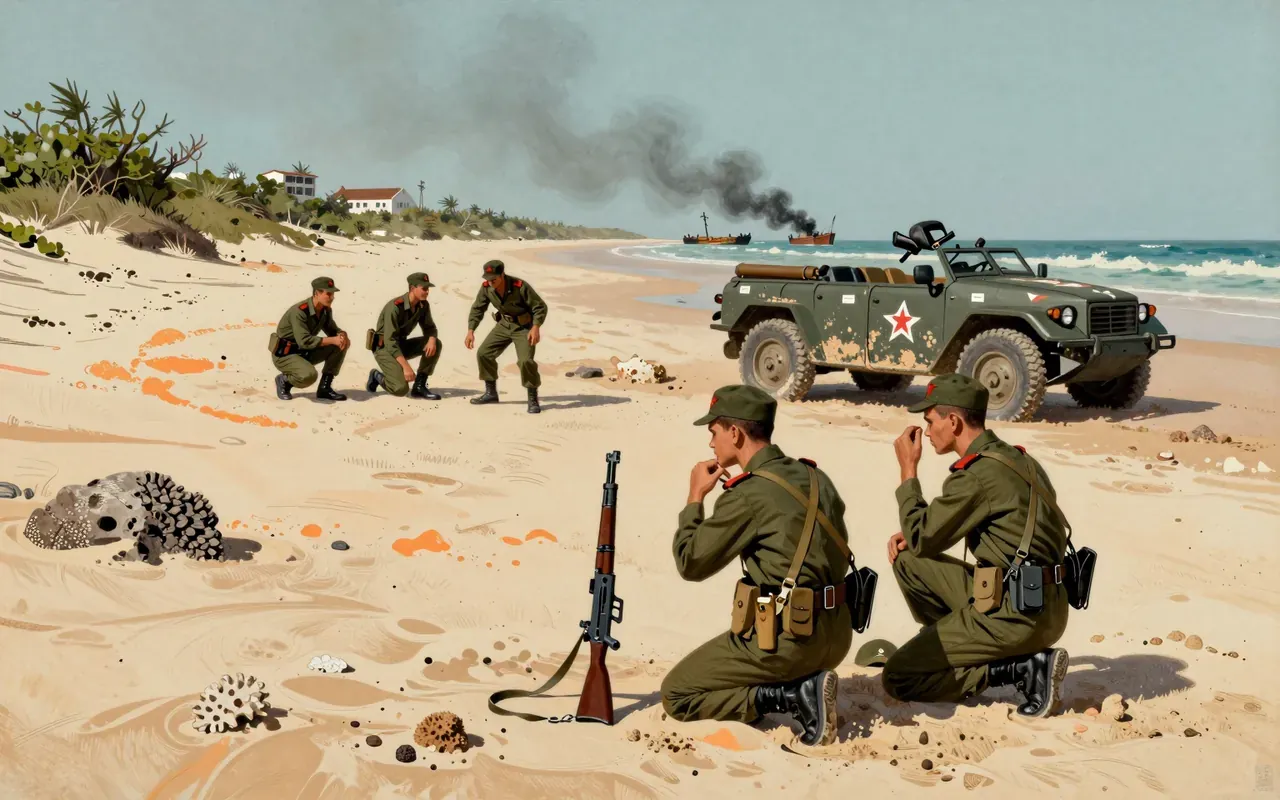
The crisis began in earnest on 14 October 1962, when a U-2 reconnaissance flight photographed Soviet nuclear missile installations under construction in Cuba, following an agreement reached that July between Nikita Khrushchev and Fidel Castro. President Kennedy learned of the findings on 16 October and, after a week of secret deliberation with advisers, announced a naval blockade of Cuba to the American public on 22 October rather than authorising the invasion many of his military commanders wanted. Tense negotiations followed over the next six days, conducted partly in public statements and partly through secret channels, until Khrushchev agreed on 28 October to dismantle the missile sites under United Nations verification, bringing the confrontation to an end after thirteen days.
Blockade over invasion
The crisis is unusually well documented because Kennedy recorded many of his meetings with advisers, giving historians direct access to the administration’s internal deliberations rather than relying solely on later memoirs. Soviet-side documentation became available only much later, after the Cold War ended, and filled in details about Khrushchev’s own reasoning and the extent of Soviet military deployment in Cuba that were not known to American analysts at the time. Some of the most dangerous moments, including an incident involving a Soviet submarine and its nuclear-armed torpedo, only became fully known to historians decades afterward, once Soviet naval records and participant accounts were released.
How close it actually came
The blockade rather than invasion approach reflected Kennedy’s judgment that a direct assault risked immediate escalation with Soviet forces already on the ground in Cuba, even though the Joint Chiefs of Staff unanimously favoured a full-scale attack as the only solution. The crisis’s resolution depended on both leaders finding language that let each claim a version of victory: publicly, the Soviets removed the missiles and the Americans pledged not to invade Cuba; privately, the United States also agreed to withdraw missiles from Turkey and Italy, a concession Kennedy insisted be kept secret to avoid the appearance of trading away NATO allies’ security under pressure.
A deal with a hidden half
How close the crisis came to nuclear war remains a matter of degree rather than dispute, since multiple near-misses are documented: a Soviet submarine crew, cut off from communication and believing war may have already begun, is reported to have come close to authorising a nuclear torpedo strike against American blockade ships, and an American U-2 pilot, Rudolf Anderson, was shot down and killed over Cuba during the standoff. Historians continue to weigh how much the outcome depended on individual restraint under pressure, such as the submarine officers’ decision not to fire, against how much it reflected the structural incentives both governments had to avoid war once the stakes were plain to each side.
What the archives later confirmed
The most durable institutional consequence was the establishment of the Moscow-Washington hotline, a direct communication link created specifically so that future crises would not be constrained by the slow diplomatic cables that had complicated communication in October 1962. The secret trade over Turkish and Italian missiles remained undisclosed publicly for years, meaning the popular understanding of Kennedy’s firmness prevailing over Soviet aggression was, for a long time, only part of the actual settlement. The crisis also shaped both superpowers’ subsequent caution about direct confrontation, feeding into the détente period that followed later in the decade.
A hotline and a lasting caution
This is one of the tightest and best-documented episodes of the entire Cold War, and it rewards close reading precisely because so many of its most dangerous moments were not fully understood until long after the fact. It is worth your time both as a study in crisis diplomacy and as a reminder that the public record of a resolved standoff can conceal a considerably more precarious reality underneath. It offers less on how the crisis was experienced or discussed inside Cuba itself, which appears mostly as the site of the confrontation rather than a party actively shaping its outcome.