A declaration with no borders
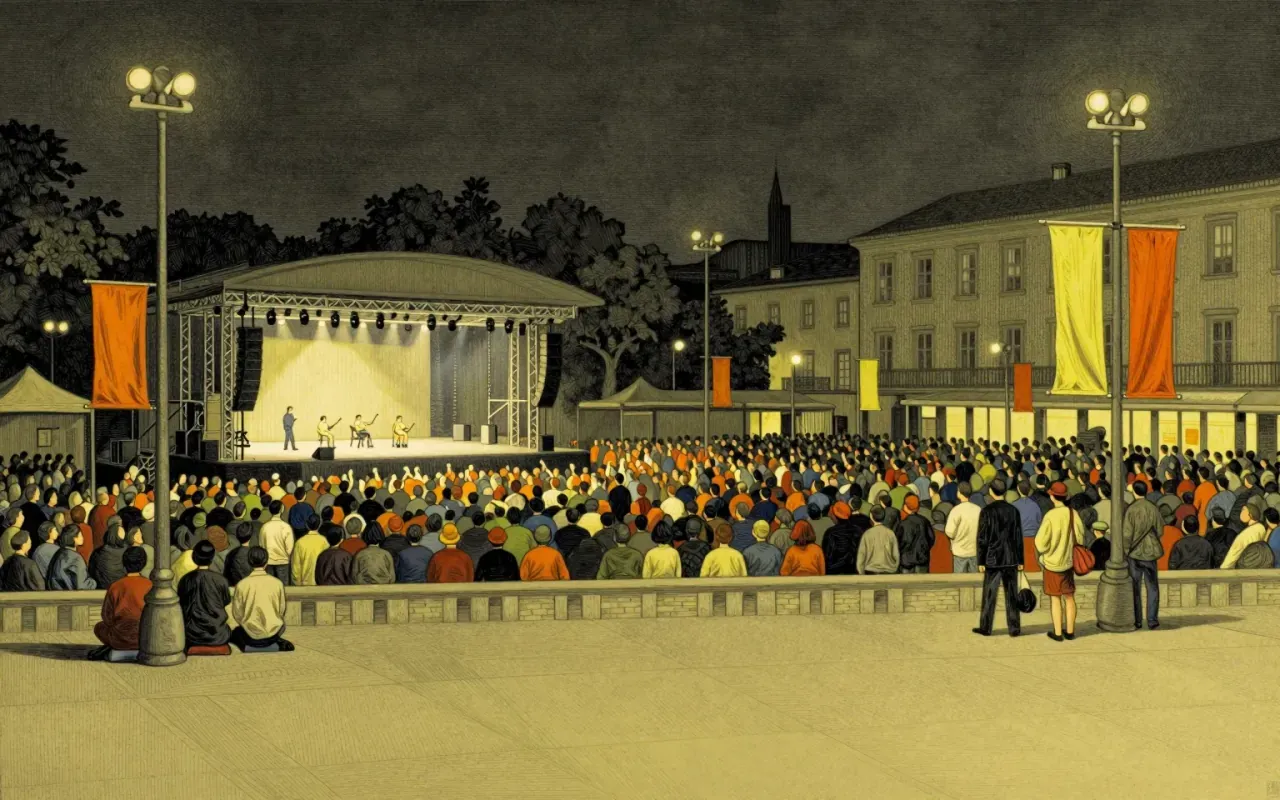
Israel’s founding took place on 14 May 1948, when David Ben-Gurion read a declaration of statehood aloud at the Tel Aviv Museum, timed to coincide with the end of the British Mandate over Palestine at midnight. Thirty-seven members of the Provisional State Council signed the document, though twelve could not attend, most because they were besieged in Jerusalem. Fighting between Jewish and Arab communities in the territory had already been under way since the United Nations partition vote the previous November, but the declaration triggered a new phase: neighbouring Arab states invaded the following day, and the resulting war continued into 1949, ending in armistice agreements rather than a negotiated peace settlement.
Sixteen minutes and thirty-seven signatures
The declaration’s drafting process is documented in unusual detail, including recorded votes among the Provisional Council on contested wording. Members voted five to four against including fixed territorial borders in the text, a deliberate choice reflecting Ben-Gurion’s view that Arab rejection of the UN partition plan meant the state’s actual extent would be settled by the coming fighting rather than by prior agreement. The war that followed is reconstructed from Israeli military records, Arab League and Palestinian sources, and later archival research, though the overall casualty and displacement record still rests on estimates rather than agreed totals, particularly on the Palestinian side.
War begins the next morning
The decision to leave borders undefined reflected the practical reality that no negotiated settlement had been reached with surrounding Arab states or Palestinian representatives, several of whom had rejected the UN partition plan outright. Once the declaration was made, the conflict shifted from a communal struggle within British-administered Palestine into an interstate war involving the armies of several Arab states, with each side’s territorial gains during the fighting effectively becoming the basis for the borders that followed, since no prior legal boundary commanded agreement from all parties involved. This meant the war itself, rather than any prior diplomatic agreement, functioned as the actual mechanism by which the new state’s territorial extent was ultimately decided on the ground.
Numbers that will not settle
Casualty figures vary by source: Israeli military deaths are generally put between roughly 5,700 and 6,400, while Arab military losses are estimated much more broadly, from about 5,000 to 20,000, a spread attributed to gaps in record-keeping and differing methods of counting. The displacement of more than 700,000 Palestinians, an event Palestinians commemorate as a catastrophe, is itself the subject of a long-running historiographical divide: accounts sympathetic to the early Israeli state have generally stressed defensive necessity and voluntary flight, a group of later Israeli historians working from newly available archives has documented specific instances of expulsion, and Palestinian and Arab historical accounts centre the episode as a deliberate act of dispossession, with no single account commanding universal acceptance among historians.
Four names for one war
The war’s end brought armistice agreements in 1949 rather than a comprehensive peace, establishing what became known as the Green Line and dividing the remaining Palestinian territory between Egyptian administration of the Gaza Strip and Jordanian control of the West Bank. A separate but related consequence was the subsequent emigration of hundreds of thousands of Jews from various Arab states in the years that followed, a movement sometimes invoked in later political arguments as a counterpart to Palestinian displacement, though the two population movements differed considerably in their causes and circumstances.
Lines drawn by armistice, not treaty
This material rewards close reading because it treats the founding of Israel as a genuinely contested historical event rather than settling on one national narrative, laying out how differently Zionist, Palestinian, Arab, and revisionist Israeli historians each frame the same eighteen months. It is particularly strong on the deliberate ambiguity built into the founding declaration itself. It is less useful if you are looking for a resolved account of exactly how much of the Palestinian exodus was coerced, a question the sources here leave open rather than answer. Readers wanting a single definitive account of the exodus’s causes should expect instead to weigh several genuinely competing scholarly traditions against each other.