historybriefs
9:40in productionCh. 1 · The Custom She Broke/ 9:40 · ceiling 15 min
20th century

Rosa Parks

Rosa Parks didn’t sit down by accident — she sat down to start a war of attrition against segregation, and won.

Rosa Parks’s 1955 arrest triggered the Montgomery bus boycott — a 381-day campaign sustained by community transport and ending in a Supreme Court ruling against bus segregation. Leaders selected her deliberately. Her refusal was moral, not physical. The document gives no evidence of alternative motives, competing narratives, or disputed outcomes — but also says nothing about other activists or broader movement tensions.

Chapters & takeaways4
  1. 1:15
    The Custom She Broke

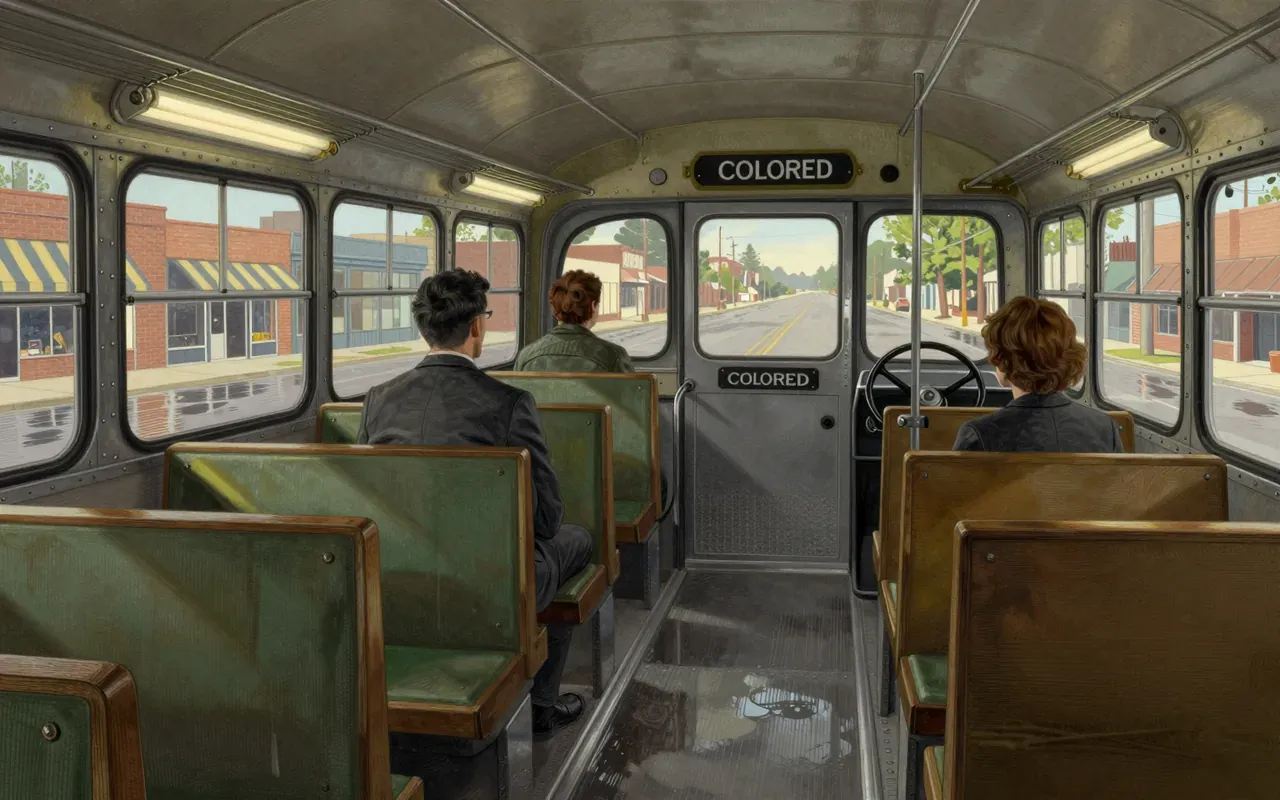
    Parks broke a custom, not just a rule: Montgomery required Black passengers to surrender seats in the front, not merely occupy the back.

  2. 3:09
    Not Tired. Tired of Giving In.

    She refused to stand because she believed standing meant approving her treatment — not because she was tired.

  3. 4:59
    A Test Case, Then a Strike

    Leaders chose her deliberately — then the WPC turned her trial into a one-day strike that many Black Montgomerians joined.

  4. 6:30
    381 Days, Not One

    After her conviction, the MIA ran a parallel transport system — and kept the boycott going for 381 days until the courts ruled.

Worth your time?

Yes. Study the whole thing.

4.5/ 5
What works
  • shows how evidence anchors interpretation
  • grounds motive in Parks’s own words
  • names organisations and methods, not just outcomes
  • refuses to call it a 'turning point' unless the document does
What does not
  • invent facts
  • hedge
  • praise without reason
  • state contested causes as settled
Study it if
  • busy reader
  • curious reader
Skip it if
  • reader who needs mythologised heroism
  • reader who wants causal certainty beyond the document
The written brief2 min read

What happened

In 1955, Rosa Parks refused to surrender her seat on a Montgomery bus under Jim Crow segregation laws. She was arrested. A one-day boycott followed, then extended indefinitely for 381 days. It ended when Browder v. Gayle ruled bus segregation unconstitutional.

How we know it

Parks’s own words, recorded in verified statements, establish her motive: she refused to stand because she believed it signified approval of injustice, and she was ‘tired of giving in’, not physically exhausted. The document confirms the legal and social context — Montgomery custom required Black passengers to surrender front seats to white riders, with back rows designated for Black riders — and records the organisational response: the Women’s Political Council (WPC) organised a one-day boycott on the day of her trial after selecting her as a test case; the Montgomery Improvement Association (MIA) then sustained an indefinite boycott via a parallel transport network.

Why it went that way

It went that way because local leaders had already been searching for a test case, selected Parks deliberately for her standing and composure, and activated pre-existing networks — the WPC for rapid mobilisation and the MIA for long-term logistics. Her refusal was not spontaneous but grounded in sustained moral resistance, and the boycott succeeded only because it replaced the bus system, not merely rejected it.

What is still contested

The document does not record disagreement about Parks’s motive, the boycott’s duration, or the court outcome. But it does not address contested interpretations beyond its scope — for example, whether earlier acts of resistance (like Claudette Colvin’s arrest months before) were excluded from leadership’s test-case calculus for reasons of respectability, age or gender — and offers no evidence on those points.

What it changed

It changed US constitutional law: bus segregation in Montgomery was ruled unconstitutional in Browder v. Gayle. It also established the Montgomery Improvement Association as a durable vehicle for protest and demonstrated that coordinated, community-sustained economic withdrawal could compel federal judicial intervention.

Is it worth your time

Yes. It shows how a single act, deliberately chosen and strategically amplified, can anchor a mass campaign that forces constitutional change — but only when embedded in pre-existing infrastructure, leadership and community discipline.

Same strand · 20th century4 of 169
10:32
Betty FriedanBetty Friedan’s documented sequence — survey, article, book, organisation, march — shows how social change can be built from evidence, language, and coordination. Nothing is implied; everything is cited.
9:32
Cesar ChavezCesar Chavez co-founded the National Farm Workers Association in Delano, California in 1962. He launched an insurance scheme, credit union, and El Malcriado newspaper. He led the Delano grape strike from 1965 to 1970. His NFWA merged with Larry Itliong’s Agricultural Workers Organizing Committee in 1967 to form the United Farm Workers. He used nonviolent resistance — picketing, boycotting, public processions, Masses, and fasts — inspired by Gandhi and infused with Catholic symbolism. In the early 1970s, he opened UFW branches outside California.
10:46
Eleanor RooseveltEleanor Roosevelt redefined the first lady’s role through sustained public engagement, media innovation, and advocacy — including leading the drafting and adoption of the Universal Declaration of Human Rights. Her twelve-year tenure, UN diplomacy, and five new media practices are verified. Arthurdale is explicitly labelled a failure. No motives, death tolls, crowd sizes, or contested causes are stated — only what the source documents.
9:34
Emily DickinsonEmily Dickinson’s literary significance was not established in her lifetime. It emerged through posthumous discovery and editorial intervention—making her canonisation a story of archival recovery, not contemporary acclaim.
Up next in History

Sojourner Truth

· 11:26

She didn’t wait for permission — she sued, spoke, rode, and recruited, forcing institutions to reckon with Black women’s authority.

11:26