A movement decades in the making
The Partition of India in August 1947 was the culmination of an independence movement usually traced to the founding of the Indian National Congress in 1885, initially a moderate body that mainly expressed loyalty to British rule rather than opposing it. Growing nationalist sentiment, sharpened by the 1905 partition of Bengal, gave rise to both revolutionary activity and, from around 1920, Mahatma Gandhi’s campaigns of non-cooperation and civil disobedience. Britain’s viceroy Lord Mountbatten announced the plan for partition in June 1947, and independence followed within weeks, with Pakistan formed on 14 August and India on 15 August, dividing a subcontinent that had been under British rule for nearly two centuries into two separate states along largely religious lines.
From loyal debating society to mass movement
The historical record draws on colonial-era census data from 1901 and 1941 used to estimate population movements, refugee camp records kept during and after the transfer of power, and a substantial body of oral history and eyewitness testimony gathered from survivors over subsequent decades. Even so, the article notes that casualty estimates still varied as recently as 2009, more than sixty years after the event, a reflection of how incomplete contemporary record-keeping was amid the speed and disorder of the transition, and how much of what is known depends on retrospective reconstruction rather than records compiled at the time.
A rushed plan and a fixed deadline
Partition’s roots lay in decades of accumulating communal and political division rather than a single decision. The 1905 Bengal partition first exposed sharp Hindu-Muslim political splits, and the two-nation theory, developed through the 1920s and 1930s, argued that Hindus and Muslims constituted distinct nations requiring separate political arrangements. The Muslim League’s growing influence after the 1937 provincial elections, combined with the Second World War period during which many Congress leaders were imprisoned while the League continued organising, shifted the balance toward eventual partition, a course that leaders including Sardar Patel within Congress eventually judged more practical to accept than to keep resisting.
A death toll that is still only a range
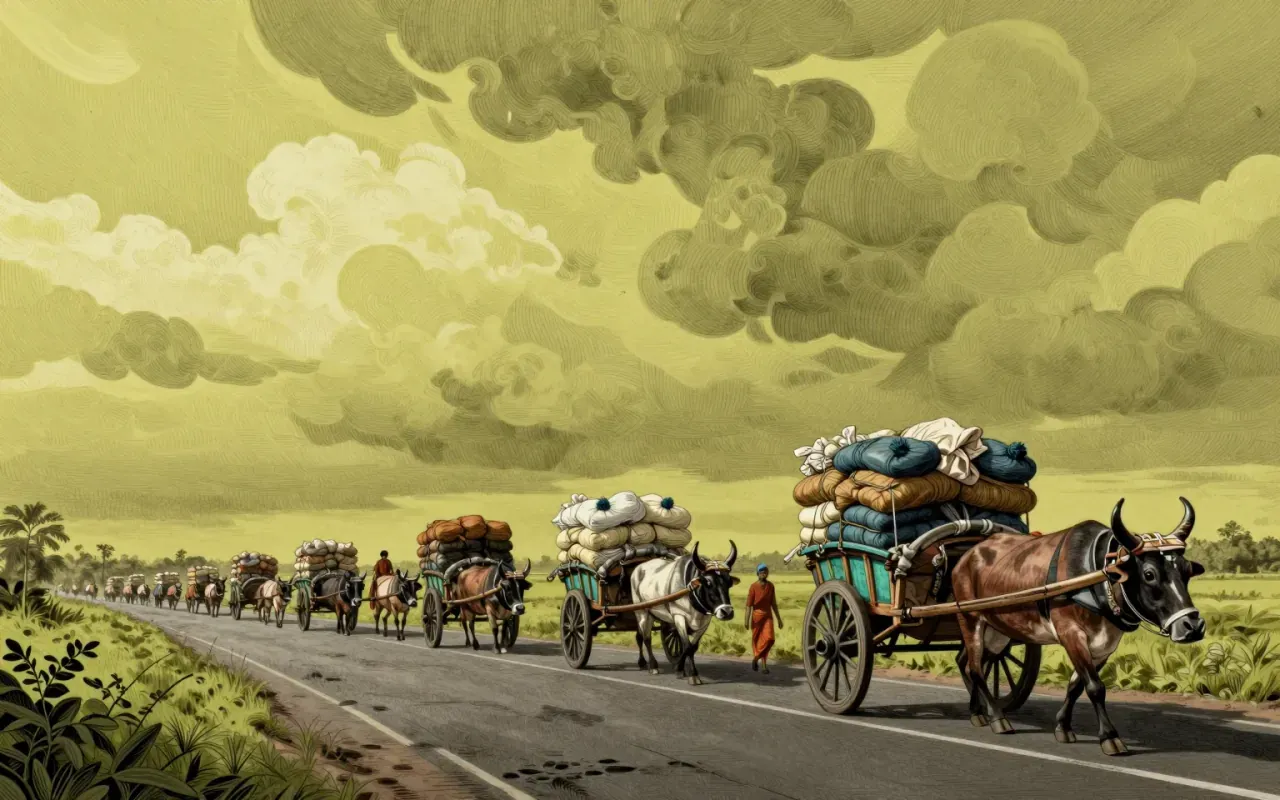
The human cost of partition is documented only as wide and disputed ranges rather than agreed figures: deaths are estimated at anywhere from 200,000 to two million, and displacement, as people crossed newly drawn religious borders in both directions, is put at between twelve and twenty million, among the largest mass migrations recorded in the twentieth century. Historians also continue to debate how inevitable partition actually was, whether British withdrawal was driven chiefly by nationalist pressure, by Britain’s own postwar economic exhaustion, or by the demands of the Second World War, and how much weight to give revolutionary movements outside the major cities compared with the more thoroughly documented urban nationalist campaigns.
Millions moved, not by choice
Partition created not only two new states but an enduring atmosphere of hostility and suspicion between them that has persisted through the decades since, including unresolved disputes over Kashmir. India adopted a republican constitution in 1950 reflecting the independence movement’s stated commitments to secular, democratic governance, though how fully that ideal was realised in practice remains itself a matter of ongoing debate. Pakistan’s own path led eventually to the further separation of Bangladesh, extending the consequences of the original 1947 division well beyond its immediate aftermath and across a second generation of political upheaval.
A hostility built into the map
This is essential reading for understanding contemporary South Asia, precisely because it resists giving you a comfortable, settled casualty figure or a clean verdict on whether partition could have been avoided. It rewards patience with genuine historical uncertainty over a tidier but less honest account. It is most useful read as the end of a much longer independence struggle rather than as an isolated event, and it says comparatively little about the specific administrative mechanics of how the new border was actually drawn on the ground, a technical process that receives far less attention here than the political and human consequences that followed it.