What happened
Signed on 6 August 1965, the Voting Rights Act targeted racial discrimination in voting. It provided federal enforcement mechanisms against practices that had kept eligible citizens from the ballot.
The National Archives says the act was signed 95 years after the Fifteenth Amendment was ratified. In those years, it says, African Americans in the South faced poll taxes, literacy tests and other bureaucratic restrictions, and risked harassment, intimidation, economic reprisals and physical violence when they tried to register or vote. Congress passed the bill on August 5, 1965, and President Lyndon Johnson signed it the next day.
How we know it
The original law and historical overview are preserved by the National Archives. They explain the 1965 arrangements; the original text should not be treated as a description of every later amendment or court decision.
The Archives page carries the enrolled text, titled “An act to enforce the fifteenth amendment.” Section 2 reads: “No voting qualification or prerequisite to voting, or standard, practice, or procedure shall be imposed or applied by any State or political subdivision to deny or abridge the right of any citizen of the United States to vote on account of race or color.” The Archives adds that Section 2 closely followed the language of the 15th Amendment and applied nationwide.
Why it went that way
Constitutional guarantees had not prevented discriminatory registration practices. The act responded by giving federal authorities a more direct role where ordinary protections had failed.
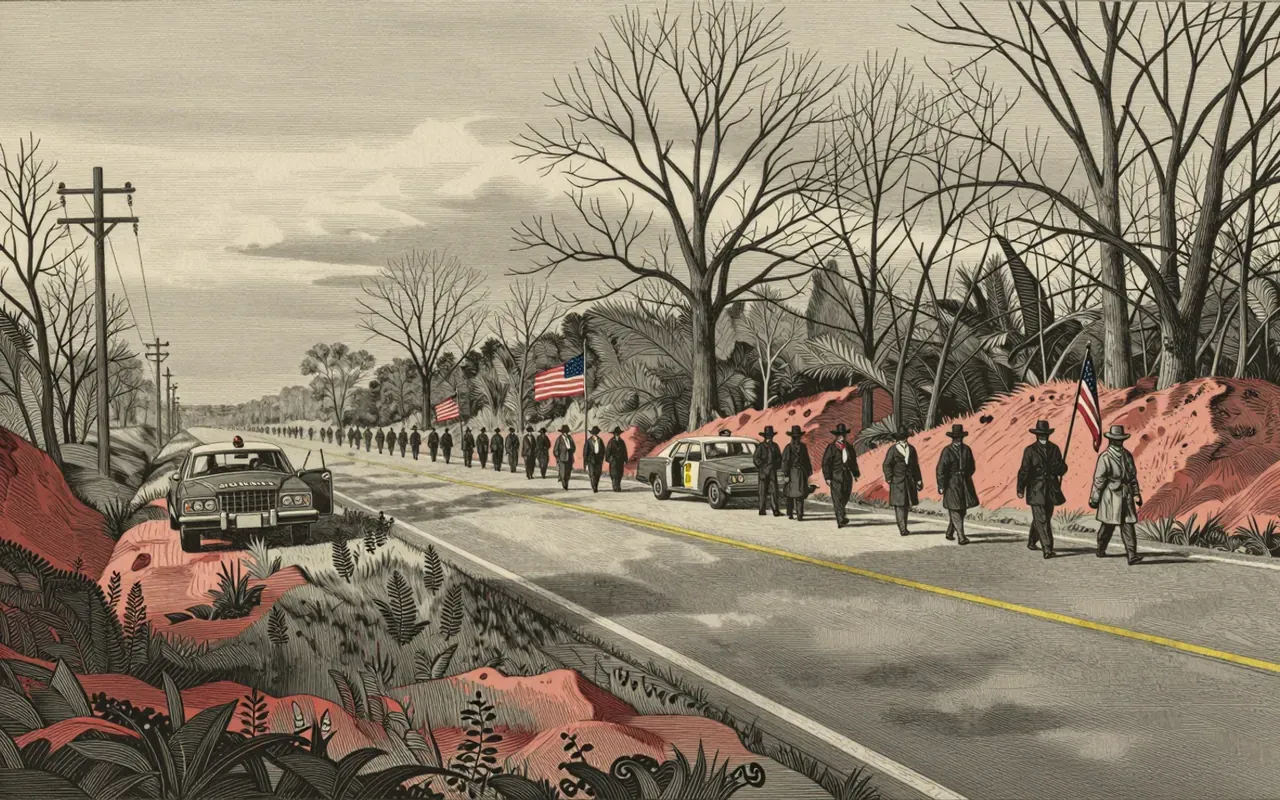
The Archives ties the timing to 1964 and 1965. Numerous peaceful demonstrations were organized in 1964, and the violence they met brought renewed attention to voting rights. It names the murder of voting-rights activists in Mississippi and the attack by white state troopers on peaceful marchers in Selma, Alabama, as events that gained national attention and persuaded Johnson and Congress to pursue national legislation. Its account credits the combination of public revulsion to the violence and Johnson’s political skills with moving Congress to pass the bill.
What is still contested
The distinction between formal eligibility and practical access is central. A right on paper could be obstructed through tests and administration without being openly repealed.
The act’s definition of a “test or device” shows how many forms the obstacle took. It covered any requirement that a person demonstrate the ability to read, write, understand or interpret any matter; demonstrate educational achievement or knowledge of a subject; possess good moral character; or prove qualifications by the voucher of registered voters or members of another class.
What it changed
The legislation suspended literacy tests in covered circumstances and authorized federal examiners. It changed the relationship between federal oversight and local control of elections.
Which places were “covered” was set by a formula in Section 4(b): a state or subdivision where the Attorney General determined that a test or device was maintained on November 1, 1964, and the Director of the Census determined that fewer than 50 percent of voting-age residents were registered on that date, or fewer than 50 percent voted in the November 1964 presidential election. Federal examiners, the Archives says, had the power to register qualified citizens in covered jurisdictions. Section 5 required those jurisdictions to obtain “preclearance” from the District Court for the District of Columbia or the Attorney General before using any new voting practice. The act also directed the Attorney General to challenge poll taxes in state and local elections.
The Archives reports results and challenges. By the end of 1965 a quarter of a million new Black voters had been registered, one-third by federal examiners, and by the end of 1966 only four of 13 southern states had fewer than 50 percent of African Americans registered. The act was challenged in court at once; between 1965 and 1969 the Supreme Court issued several decisions upholding Section 5, and in 2013 the Court struck down a key provision involving federal oversight of voting rules in nine states. The act was readopted and strengthened in 1970, 1975 and 1982.
Is it worth your time
Worth studying through a registration process rather than an abstract promise. Ask how an eligible person was excluded and which enforcement power addressed that obstacle; this makes the law’s historical purpose concrete.