From the Bastille to Ferney
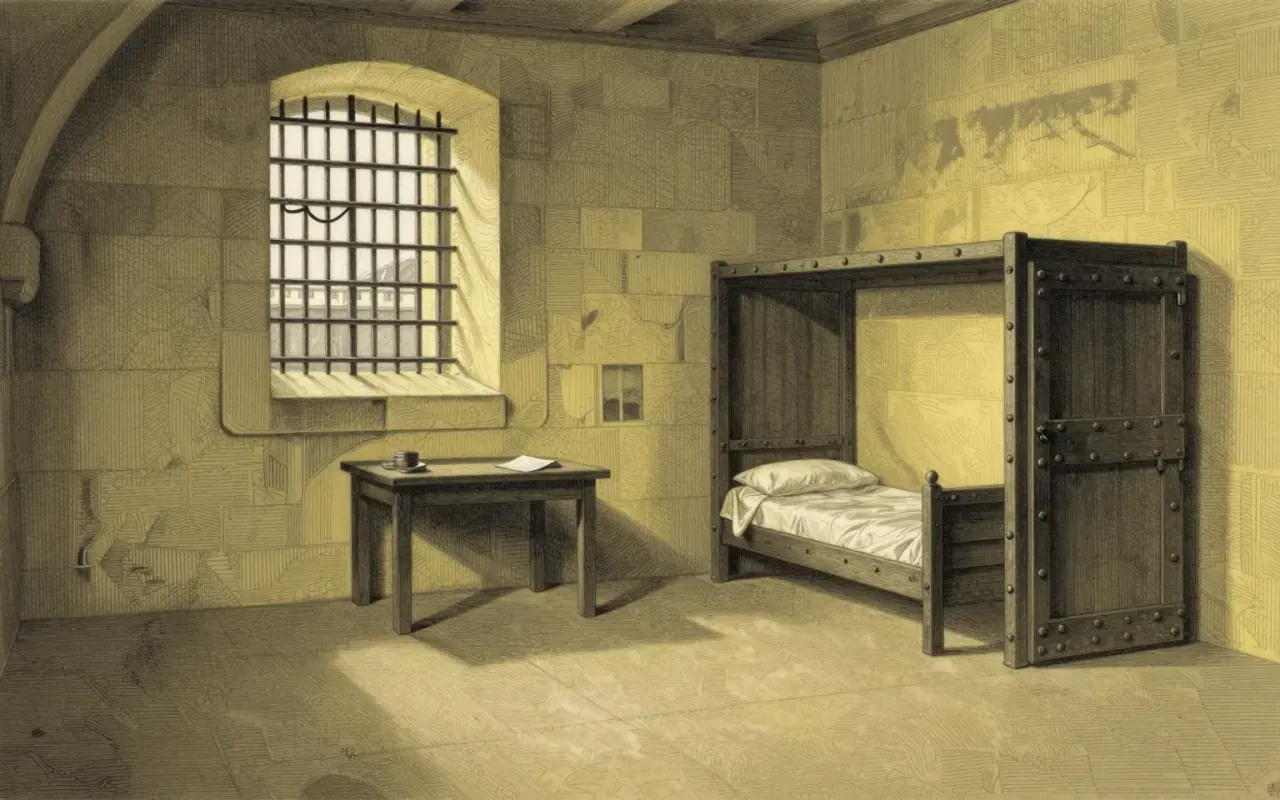
Voltaire, born Francois-Marie Arouet in Paris in 1694, built an early reputation as a playwright and satirist, and spent eleven months imprisoned in the Bastille in 1717 over a satirical verse before a later dispute led him to request exile in England instead of further imprisonment in 1726. His two and a half years there shaped his lasting admiration for English constitutional government and religious toleration. Back in France, he spent sixteen years, from 1733, largely at a country estate with the mathematician and physicist Emilie du Chatelet, and after her death moved to the Prussian court of Frederick the Great before eventually settling for the last two decades of his life at Ferney, near the Swiss border, where he wrote Candide and campaigned publicly against specific miscarriages of justice. He died in Paris in 1778 at eighty-three.
Twenty thousand letters, one disputed deathbed
Voltaire left an extraordinarily large paper trail, writing more than twenty thousand letters over his lifetime, a body of correspondence later collected into a scholarly edition running to over a hundred volumes and providing historians with an unusually detailed record of his daily concerns, friendships and controversies. Even so, some basic facts remain genuinely disputed, including exactly what happened and what he actually said on his deathbed, since hostile and sympathetic witnesses gave sharply conflicting accounts, some claiming a religious recantation and others reporting continued defiance, and historians now generally conclude the precise truth cannot be firmly established from the surviving, contradictory testimony.
Crushing the infamous, one case at a time
Voltaire held to a form of deism, believing in a necessary supreme being while firmly rejecting the specific doctrines and institutional authority of organised religion, and he used his considerable public platform to campaign against what he saw as religious persecution and clerical abuse of power, most famously in his published exposure of the wrongful conviction and execution of the Protestant merchant Jean Calas, a case he helped have formally overturned. He argued that intolerance and superstition caused enormous social harm, urging readers toward reasoned scepticism instead, and his account of England’s comparatively greater religious and political freedom, drawn from his own period of exile there, became an influential point of comparison used to criticise French absolutism directly.
A quotation he never actually said
A widely circulated quotation expressing his supposed personal commitment to defending views he disagreed with does not actually come from Voltaire at all, but from a 1906 biography in which the author, writing under a pseudonym, paraphrased his general attitude in her own words, a paraphrase later mistaken for a direct quotation and repeated as such ever since. His financial and legal disputes during his time at the Prussian court, including accusations of theft and forgery involving a Jewish financier named Abraham Hirschel, are cited by some scholars examining his broader recorded views on Jewish people and race, an aspect of his legacy modern historians treat as a genuine and unresolved blemish on his reputation for tolerance rather than something to set aside.
A historian’s method, a companion’s overlooked genius
Voltaire helped reshape historical writing itself, arguing against supernatural explanations for events and pushing historians toward treating economics, culture and broader social patterns as seriously as military and diplomatic narrative, an approach that influenced how history came to be written as a discipline. The French National Assembly, regarding him as a forerunner of the Revolution, had his remains ceremonially moved to the Pantheon in 1791, reportedly drawing a crowd estimated in the hundreds of thousands. His companion Emilie du Chatelet’s own scholarly contribution, including her translation of Newton’s Principia into French that remained the standard version for centuries, is now given far more independent credit by historians than earlier accounts, which tended to present her chiefly as Voltaire’s companion rather than as a serious scholar in her own right.
An advocate for tolerance with an unresolved blemish
Voltaire is worth attention for the sheer density of his surviving correspondence, which lets historians reconstruct his daily life and controversies in unusual detail, set against the genuine and still-debated blemishes on his record, including his documented views on Jewish people, that complicate his reputation as an uncomplicated champion of tolerance. Readers interested in Enlightenment debates over religious freedom, or in how a misattributed quotation can become more famous than anything its supposed author actually wrote, will find the material genuinely engaging to explore. Readers wanting an entirely consistent, unblemished advocate for tolerance should expect the fuller record to complicate that image rather than confirm it.