An economic grievance becomes an insurgency
The Malayan Emergency began on 16 June 1948 with the Sungai Siput incident, in which three European plantation managers were killed, opening a conflict that would run officially until 1960 and, in a renewed form, until 1989. Its roots lay in postwar economic disruption: widespread unemployment and inflation followed the end of Japanese occupation, and British authorities suppressed trade union organising through strikebreaking, mass dismissals and arrests, provoking communist militants to target strikebreakers and plantation estates directly. Denial of citizenship to roughly 90 percent of Malaya’s ethnic Chinese population compounded these grievances, feeding recruitment into the Malayan National Liberation Army, the armed wing of the Malayan Communist Party under Chin Peng, which never numbered more than around eight thousand full-time fighters even at its documented 1951 peak.
A million people moved behind wire
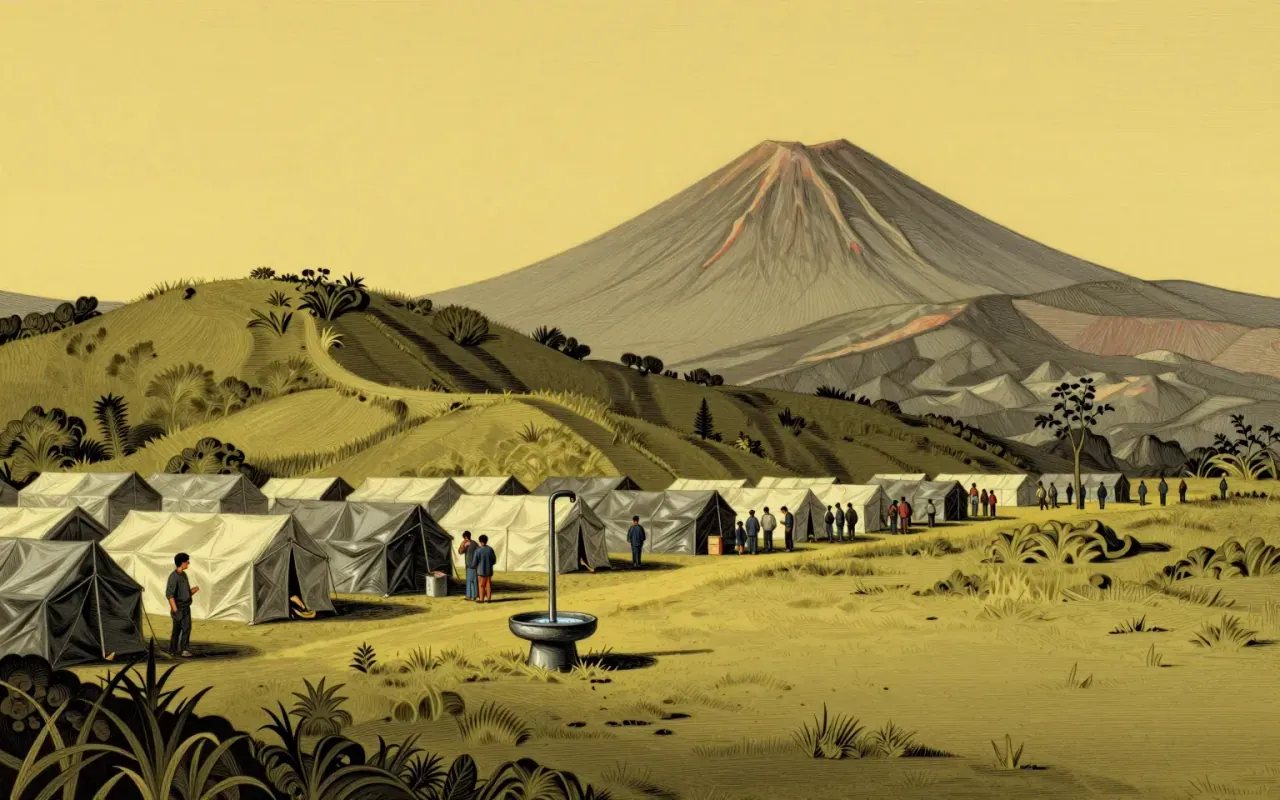
British and Commonwealth forces, eventually including troops from Australia, New Zealand, Kenya, Southern Rhodesia and Fiji alongside 40,000 regular soldiers, 250,000 Home Guard and 66,000 police, pursued a strategy centred on General Harold Briggs’s plan to cut the insurgency off from its rural support base. This involved forcibly relocating approximately one million civilians into fortified new villages, surrounded by barbed wire and searchlights, an approach historians have compared in structure, though not necessarily in stated intent, to concentration camps, and one that removed the guerrillas’ access to food, intelligence and recruits from the wider rural population regardless of individual villagers’ actual political sympathies.
Credit given to the wrong general, some argue
Historiographical assessment of the campaign’s turning point remains contested. The traditional account credits General Gerald Templer, who arrived in 1952, with the tactical innovations that ultimately broke the insurgency’s momentum, but revisionist historians, drawing on sinologist Victor Purcell’s earlier critique, argue Templer largely continued policies his predecessors had already initiated rather than introducing a genuinely new approach. This debate matters because the Templer narrative has shaped how the Malayan Emergency is taught within later counterinsurgency doctrine internationally, meaning an inaccurate account of who actually deserves credit could have propagated flawed lessons into subsequent conflicts that drew on the Malayan model.
Britain’s My Lai
The campaign produced documented atrocities alongside its counterinsurgency achievements. The Batang Kali massacre, in which British troops executed twenty-four unarmed villagers, was reported at the time as an extrajudicial killing in violation of the Geneva Conventions and has since been described in press accounts as Britain’s My Lai, an explicit comparison to the American atrocity in Vietnam. Britain also became the first country to use herbicides, notably a chemical similar to the later Agent Orange, against guerrilla positions and food crops, with an estimated ten thousand or more civilians and combatants affected by the defoliant’s health impacts, though many historians believe the true figure was considerably higher than what was formally documented at the time.
A herbicide precedent Washington later studied
The conflict’s casualty toll stood at over eleven thousand deaths by its official 1960 conclusion, including 1,443 Commonwealth personnel killed, 6,710 MNLA fighters killed alongside several thousand more captured or surrendered, and 2,478 documented civilian deaths with hundreds more listed as missing. The emergency’s herbicide precedent had a documented afterlife beyond Malaya itself: US Secretary of State Dean Rusk cited Britain’s earlier use of defoliants when advising President Kennedy on strategy in Vietnam, a direct line from one counterinsurgency campaign’s tactics to another’s adoption of a similar and similarly controversial method years later.
An emergency that reopened nearly a decade later
Though officially concluded in 1960, the conflict was not truly finished: Chin Peng renewed communist insurgency against the newly formed Malaysia in 1968, and this second phase continued until a peace agreement in 1989, meaning the full Malayan Emergency, understood as a continuous political and sometimes military struggle, spanned over four decades rather than the twelve years usually cited. The campaign rewards study precisely because its celebrated counterinsurgency doctrine sits alongside forced civilian relocation, a well-documented massacre and a herbicide precedent later echoed in Vietnam, evidence that a counterinsurgency campaign judged successful by its own side’s military historians can simultaneously carry a substantial and separately documented human cost.