What happened
Approved on 6 May 1882, the Chinese Exclusion Act barred immigration by Chinese laborers for ten years. It also restricted naturalization and imposed documentation requirements affecting Chinese residents and travelers.
The National Archives calls it the first significant law restricting immigration into the United States, and notes that it was signed by President Chester A. Arthur. Its formal title was “An act to execute certain treaty stipulations relating to Chinese.” The preamble gives the stated reason: in the opinion of the United States government, the coming of Chinese laborers endangered the good order of certain localities. The suspension began after ninety days and ran for ten years from passage. A ship’s master who knowingly landed a Chinese laborer was guilty of a misdemeanor, with a fine of up to five hundred dollars for each one and possibly up to a year in prison.
How we know it
The statute survives with a transcript in the National Archives. Its definitions and certification rules show how exclusion operated through categories, paperwork and enforcement, not merely a statement of hostility.
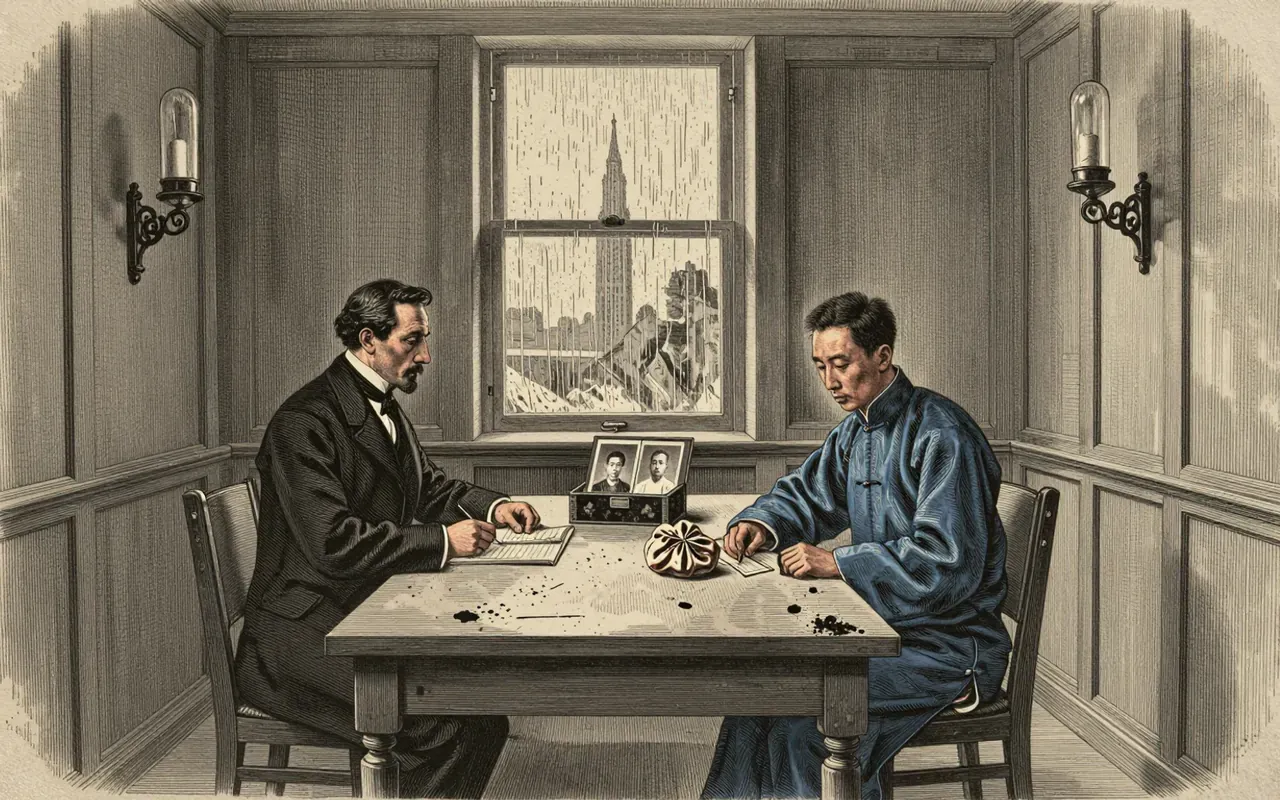
The text defines its terms. Section 15 says “Chinese laborers” means skilled and unskilled laborers and Chinese employed in mining. Laborers who were in the country on 17 November 1880, or who arrived within ninety days of passage, were not covered by the ban, provided they could produce the required evidence. Before leaving, they could obtain a certificate, recorded in a registry book with their name, age, occupation, last place of residence and physical marks, which allowed them to re-enter. Any Chinese person found unlawfully in the country could be removed at the direction of the President, after being brought before a judge or commissioner. Section 14 barred state and federal courts from admitting Chinese to citizenship.
Why it went that way
The law singled out an ethnic working population as a supposed danger to public order. That premise turned discriminatory claims into federal restrictions on movement and membership.
What is still contested
Describing the act as a ban on every Chinese person misses its exemptions. Those exemptions did not make the system equitable: proving an eligible status could itself be difficult.
The act required the few non-laborers who sought entry, such as diplomatic officers, to obtain certification from the Chinese government. Section 6 required each certificate to be in English or accompanied by a translation, and to state the holder’s name, title or rank, age, height, physical peculiarities, occupation and place of residence in China. Diplomatic and other officers traveling on government business were exempt under Section 13, and their credentials counted as the certificate. The National Archives says that because the act defined laborers so broadly, the non-laborer group found it increasingly difficult to prove their status, and very few Chinese could enter under the law.
What it changed
Congress extended the restrictions, and exclusion outlasted the original ten-year term. Repeal in 1943 did not establish unrestricted immigration; a restrictive quota remained.
When the act expired in 1892, Congress extended it for ten years in the Geary Act, and made the extension permanent in 1902. The National Archives says the Geary Act added a requirement that each Chinese resident register and obtain a certificate of residence, and that without one they faced deportation. In 1943, when China was a member of the Allied Nations in the Second World War, Congress repealed all the exclusion acts. According to the National Archives, quotas remained, leaving a yearly limit of 105 Chinese immigrants, and foreign-born Chinese won the right to seek naturalization. In 2011 and 2012 Congress condemned the Chinese Exclusion Act, with the Senate unanimously passing Senate Resolution 201 and the House unanimously passing House Resolution 683.
Is it worth your time
Worth reading alongside immigration records. The connection between legal categories and the documents people had to produce reveals how national policy shaped ordinary journeys, family ties and residence.